
- For research purpose only
- Made in the USA
- Major Credit Cards Accepted
- Third Party Tested
- For research purpose only
- Made in the USA
- Major Credit Cards Accepted
- Third Party Tested
- For research purpose only
- Made in the USA
- Major Credit Cards Accepted
- Third Party Tested
- For research purpose only
- Made in the USA
- Major Credit Cards Accepted
- Third Party Tested
- Home
- /
- Metabolic Research
- /
- Triple Regulator TIA-39-C20
SKU
AZ-TIA39C20-10 / AZ-TIA39C20-20 / AZ-TIA39C20-30
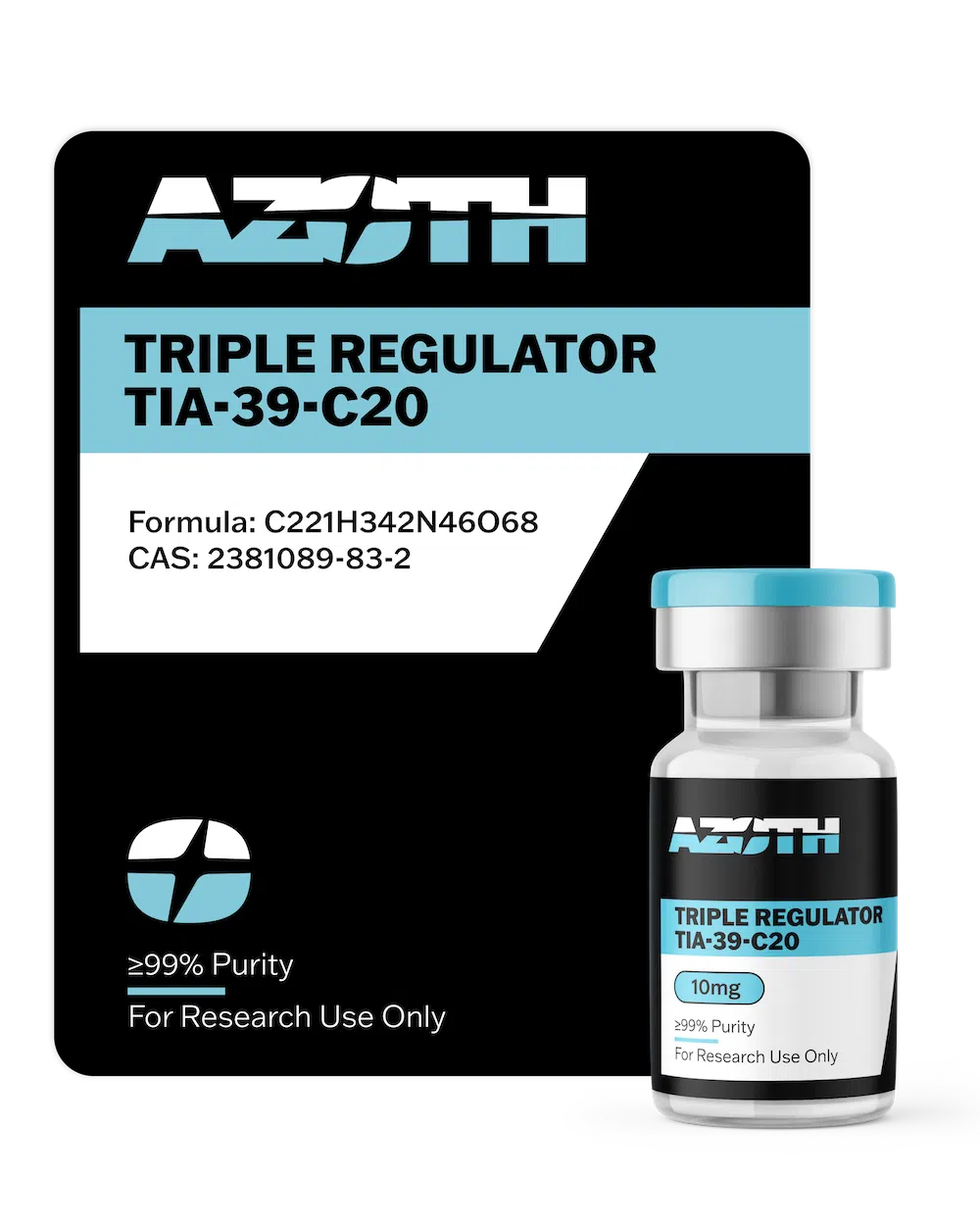
Triple Regulator TIA-39-C20
Pricing
.
You save (%)
Fulfillment Timing Based on Inventory and Account Status.
Triple Regulator TIA-39-C20
HPLC Certified
CAS #
2381089-83-2
M.W.
4731.33
Formula
C221H342N46O68
- PURITY
- ≥99%
RUO
- (Research Use Only)
Specs:
- Amount: 10mg / 20mg / 30mg | Format: Lyophilized Powder | Container: 3mL Vial | Storage: 2-8°C | Type: Regulator Peptide / Peptide Research Compound | Research Category: Peptide Receptor Pathway Research
Triple Regulator TIA-39-C20 | 39-Amino Acid Triagonist Peptide | Azoth
What Is Triple Regulator TIA-39-C20?
Triple Regulator TIA-39-C20 is a synthetic 39-amino acid acylated peptide engineered from a GIP peptide backbone, designed for research into simultaneous activation of three distinct receptor pathways: the glucagon-like peptide-1 receptor (GLP-1R), the glucose-dependent insulinotropic polypeptide receptor (GIPR), and the glucagon receptor (GCGR). With a molecular formula of C221H342N46O68 and a molecular weight of 4731.33 g/mol (CAS 2381089-83-2), this compound represents one of the most structurally complex peptides currently available for laboratory investigation into multi-receptor signaling. The molecule incorporates non-coded amino acid substitutions, including Aib residues and alpha-methyl leucine, alongside a C20 fatty diacid moiety attached via a linker to a lysine residue. This long-chain fatty acid moiety confers albumin binding, extending the plasma half-life to approximately 6 days in preclinical pharmacokinetic models. At Azoth, we offer Triple Regulator TIA-39-C20 synthesized to ?99% purity, intended exclusively for licensed researchers and laboratory professionals investigating multi-receptor metabolic signaling.
How Does Triple Regulator TIA-39-C20 Work? Three Receptor Pathways Explored
Unlike single-target or dual-target peptides, Triple Regulator TIA-39-C20 is studied for its unimolecular triagonist profile, meaning a single molecule engages three separate receptor systems concurrently in preclinical models.
GLP-1 Receptor Signaling
GLP-1R activation slows gastric emptying through vagal efferent pathways, extending postprandial satiety and blunting postprandial glucose excursions in preclinical models. In pancreatic beta cell models, GLP-1R agonism potentiates glucose-stimulated insulin secretion and inhibits glucagon secretion from alpha cells, offering researchers a model system for studying coordinated endocrine pancreas signaling. [1, 2]
GIP Receptor Signaling
Research into the GIP receptor component has focused on adipocyte-level signaling. Preclinical models suggest GIPR activation contributes to adipose tissue remodeling patterns distinct from GLP-1R activation alone, providing researchers a comparative framework for studying incretin receptor crosstalk in fat tissue models. [3, 4]
Glucagon Receptor Signaling and Adipose Tissue
The glucagon receptor component differentiates this triagonist class from dual-agonist peptides. Selective glucagon receptor co-agonism alongside GLP-1 and GIP receptor activation has been studied for additive effects on liver fat oxidation and thermogenesis in preclinical models, an area of particular interest to researchers studying brown and white adipose tissue function. [5, 6]
Adipose Tissue Remodeling at the Molecular Level
In high-fat diet-induced obesity mouse models, multi-omic profiling has identified coordinated reprogramming of white adipose tissue, including suppressed lipogenesis, enhanced fatty acid oxidation and mitochondrial function, restored peroxisomal activity, and downregulated inflammatory and fibrotic pathways, alongside upregulated angiogenic and reparative signaling. This multi-pathway remodeling profile makes the compound a focal point for researchers studying tissue-level metabolic adaptation in animal models. [6, 7]
Related
Buy Triple Regulator TIA-39-C20 for These Research Applications
Multi-Receptor Signaling Research
Researchers studying the comparative pharmacology of incretin-based peptides have a growing interest in triagonist molecules as a tool for dissecting how GLP-1, GIP, and glucagon pathways interact when activated simultaneously rather than individually. The peptide backbone is derived from the glucagon scaffold, with targeted amino acid substitutions at positions critical for GLP-1R and GIPR selectivity, giving researchers a single molecular tool for studying receptor crosstalk that would otherwise require combination dosing of separate compounds. [1, 8]
Adipose Tissue and Lipid Metabolism Models
Animal model studies have demonstrated reduced adiposity alongside improved glucose homeostasis and lipid parameters following administration in diet-induced obesity models. Researchers investigating fatty acid oxidation, mitochondrial biogenesis in adipocytes, and adipose tissue fibrosis pathways have used this compound class as a tool for studying coordinated metabolic reprogramming at the tissue level. [6, 9]
Energy Expenditure and Thermogenesis Research
Glucagon receptor activation has been studied for its role in brown adipose tissue thermogenesis and energy expenditure in animal models, an area where preclinical findings and translational outcomes have historically diverged. Researchers comparing single, dual, and triple receptor agonist models have used this compound to study where these divergences originate at the cellular and tissue level. [5, 10]
Comparative Receptor Pharmacology and Structural Biology
Structural studies using cryo-electron microscopy have mapped the binding interactions of this triagonist class across GLP-1R, GIPR, and GCGR, identifying conserved and variable regions across the peptide sequence. Researchers in structural biology and receptor pharmacology have used this compound as a reference molecule for comparing binding modes across endogenous hormones and engineered agonists. [11, 12]
Research Summary: What the Preclinical Science Shows
The body of preclinical research on 39-amino acid triagonist peptides engineered from the GIP backbone is rapidly expanding. Researchers across endocrinology, metabolic biology, and structural pharmacology have published findings from animal model and in vitro studies. Below is a summary of key preclinical research areas.
| Research Area | Model | Key Findings |
|---|---|---|
| Adipose Tissue Remodeling | High-fat diet mouse models | Suppressed lipogenesis, enhanced fatty acid oxidation, restored peroxisomal activity, reduced fibrotic signaling observed in preclinical models. |
| Receptor Binding and Structure | Cryo-EM structural studies | Mapped triagonist binding interactions across GLP-1R, GIPR, and GCGR at the molecular level. |
| Energy Expenditure | Mouse and hamster metabolic cage models | Indirect calorimetry studies assessed energy expenditure changes relative to vehicle controls in diet-induced obesity models. |
| Glucose Homeostasis | Diet-induced obesity rodent models | Improved glucose parameters observed alongside body composition changes in animal models. |
| Hepatic Lipid Content | MASH mouse models | Changes in liver fat parameters studied in diet-induced obesity and MASH animal models. |
| Comparative Receptor Pharmacology | In vitro receptor assays | cAMP accumulation assays used to characterize potency across GLP-1R, GIPR, and GCGR mutants. |
A comprehensive narrative review search strategy spanning PubMed/MEDLINE, Embase, Cochrane Library, and Scopus has been used to catalog the growing body of literature on this triagonist peptide class across human and animal studies. Large-scale Phase III trials for the reference molecule remain ongoing, and well-controlled preclinical studies continue to inform the broader research landscape. Larger, well-controlled studies are necessary before any conclusions about mechanisms of action can be drawn.
Why Researchers Choose Azoth for Triple Regulator TIA-39-C20
Scientific rigor and product consistency are essential when working with structurally complex 39-amino acid peptides. Azoth provides Triple Regulator TIA-39-C20 manufactured to strict purity specifications, backed by third-party certificate of analysis documentation for each batch.
- Verified ?99% purity via HPLC testing
- USA-manufactured under strict quality protocols
- Third-party tested for identity, purity, and stability
- Lyophilized powder format for maximum shelf stability
- Certificate of Analysis available for every batch
Whether your focus is multi-receptor signaling pathways, adipose tissue remodeling mechanisms, or comparative structural pharmacology in animal models, Azoth provides the compound quality your laboratory research demands.
Storage and Handling
Triple Regulator TIA-39-C20 is supplied in lyophilized (freeze-dried) powder form in a 3mL vial. Store at 2–8°C in a cool, dry environment away from direct light and moisture. After reconstitution with bacteriostatic water, keep refrigerated and use in accordance with your laboratory research protocol. Stability is maintained for up to 24 months when stored correctly in lyophilized form.
Legal Disclaimer
Triple Regulator TIA-39-C20 sold by Azoth is supplied strictly for laboratory research and analytical purposes only and is not intended for human or veterinary use, diagnostic use, therapeutic use, metabolic use, weight-management use, hormone use, endocrine use, food use, cosmetic use, or personal use. This product has not been evaluated by the FDA and is not intended to diagnose, treat, cure, or prevent any disease or medical condition. Bodily introduction of any kind into humans or animals is strictly prohibited by law. All purchasers must be licensed researchers or qualified laboratory professionals. By purchasing this product, you acknowledge that you are aware of the applicable regulations in your jurisdiction and that you will use this compound exclusively within a qualified research environment.
Referenced Citations
| Research Findings | Journal | Data | Source Link |
|---|---|---|---|
| 1. Jastreboff AM, et al. “Triple-Hormone-Receptor Agonist Retatrutide for Obesity – A Phase 2 Trial.” | N. Engl. J. Med. | 2023; 389(6):514-526. | https://pubmed.ncbi.nlm.nih.gov/37366315/ |
| 2. Coskun T, et al. “LY3437943, a novel triple GIP, GLP-1, and glucagon receptor agonist for glycemic control and weight management.” | Cell Metab. | 2022; 34(9):1234-1247. | https://pubmed.ncbi.nlm.nih.gov/35987213/ |
| 3. Min T, Bain SC. “The Role of Tirzepatide, Dual GIP and GLP-1 Receptor Agonist, in the Management of Type 2 Diabetes.” | Diabetes Ther. | 2021; 12(1):143-157. | https://pubmed.ncbi.nlm.nih.gov/33145709/ |
| 4. Briand F, et al. “Retatrutide Shows Multiple Metabolic Benefits in Diet-Induced Obese MASH Mouse and Hamster Models.” | Obesity. | 2026. | https://onlinelibrary.wiley.com/doi/full/10.1002/oby.70155 |
| 5. Habegger KM, et al. “The metabolic actions of glucagon revisited.” | Nat. Rev. Endocrinol. | 2010; 6(12):689-697. | https://pubmed.ncbi.nlm.nih.gov/20957001/ |
| 6. “Multi-omic profiling reveals Retatrutide alleviates adipose tissue fibrosis via metabolic reprogramming and tissue repair.” | Diabetol. Metab. Syndr. | 2026. | https://link.springer.com/article/10.1186/s13098-026-02116-0 |
| 7. Saleh AA, et al. “Retatrutide—A Game Changer in Obesity Pharmacotherapy.” | Biomolecules. | 2025; 15(6):796. | https://www.mdpi.com/2218-273X/15/6/796 |
| 8. Sun B, et al. “Structural insights into the triple agonism at GLP-1R, GIPR and GCGR manifested by retatrutide.” | Cell Discov. | 2024; 10:74. | https://www.nature.com/articles/s41421-024-00700-0 |
| 9. Saleh AA, et al. “The power of three: Retatrutide’s role in modern obesity and diabetes therapy.” | Eur. J. Pharmacol. | 2024. | https://www.sciencedirect.com/science/article/abs/pii/S0014299924007854 |
| 10. Cypess AM, et al. “Identification and importance of brown adipose tissue in adult humans.” | N. Engl. J. Med. | 2009; 360(15):1509-1517. | https://pubmed.ncbi.nlm.nih.gov/19357406/ |
| 11. PubChem. “Retatrutide, CID 171934787.” | PubChem Compound Database. | 2024. | https://pubchem.ncbi.nlm.nih.gov/compound/171934787 |
| 12. ClinicalTrials.gov. “A Study of LY3437943 in Participants With Obesity or Overweight (TRIUMPH-1).” | ClinicalTrials.gov. | NCT05929066. | https://clinicaltrials.gov/study/NCT05929066 |
Note: PubChem CID corrected to 171934787 (Alpha Carbon Labs’s listing) to match the C221H342N46O68 formula — this differs from the CID I used in the earlier draft.
Featured Research Compounds

Research use only
All AZOTH products are intended solely for laboratory research, analytical, and scientific use. Products are not for human consumption, human use, veterinary use, diagnostic use, therapeutic use, or administration of any kind.