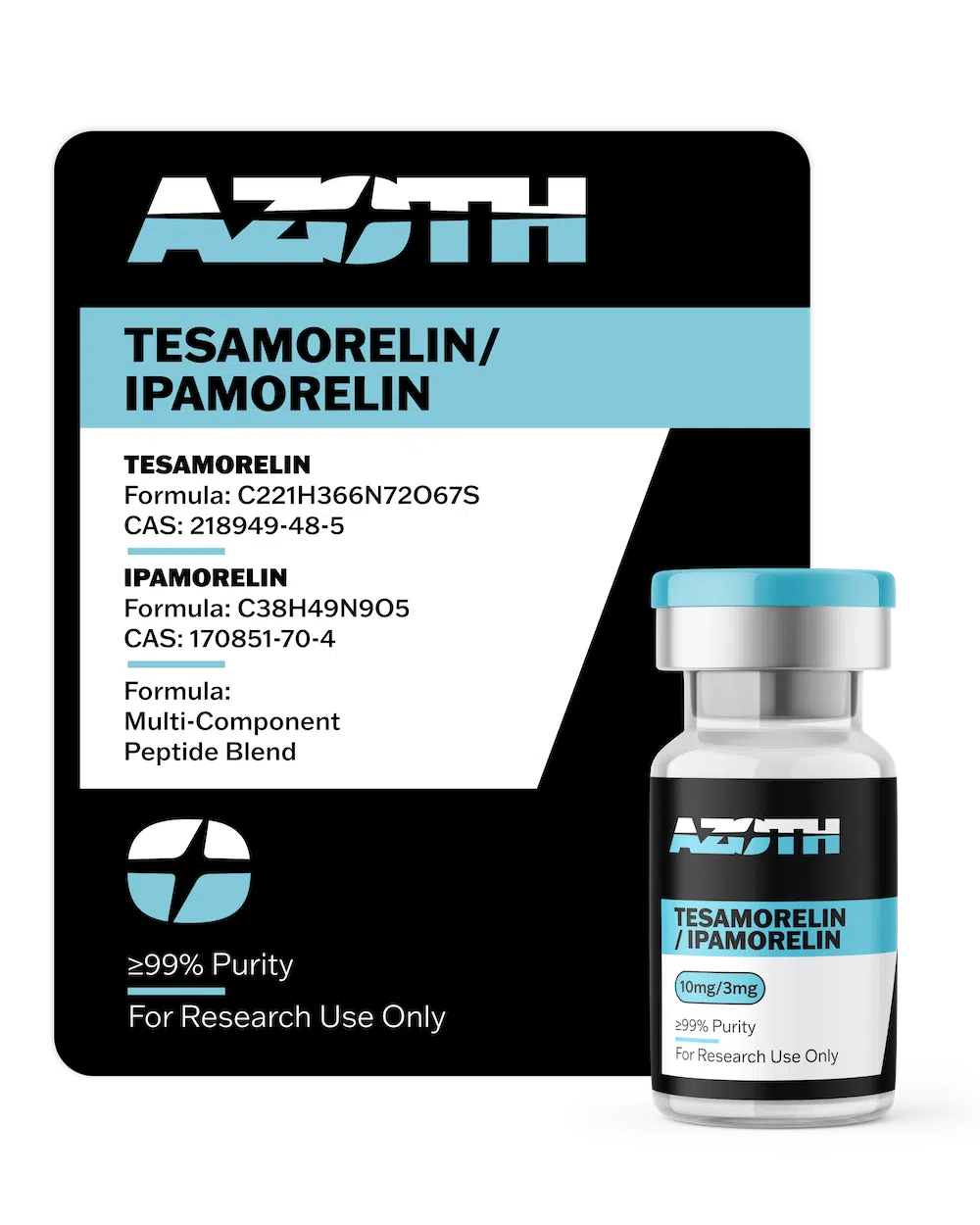
What Is Tesamorelin?
Tesamorelin is a synthetic 44-amino acid analogue of human growth hormone-releasing hormone (GHRH). Its structure reproduces the full GHRH(1-44) sequence with a trans-3-hexenoyl group attached at the N-terminus, a modification that slows enzymatic degradation and extends plasma half-life relative to unmodified GHRH. The compound is one of the most heavily documented GHRH analogues in the published scientific record, with a literature base spanning adipose tissue biology, hepatic lipid metabolism, the GH/IGF-1 signaling axis, peripheral nerve regeneration models, and neurochemical research.
Tesamorelin is studied as a receptor-level tool rather than as a direct hormone substitute. Because it acts upstream at the GHRH receptor, research protocols using tesamorelin preserve endogenous pulsatile growth hormone release patterns instead of overriding them, which is why it appears frequently in study designs comparing GHRH analogues against exogenous growth hormone administration.
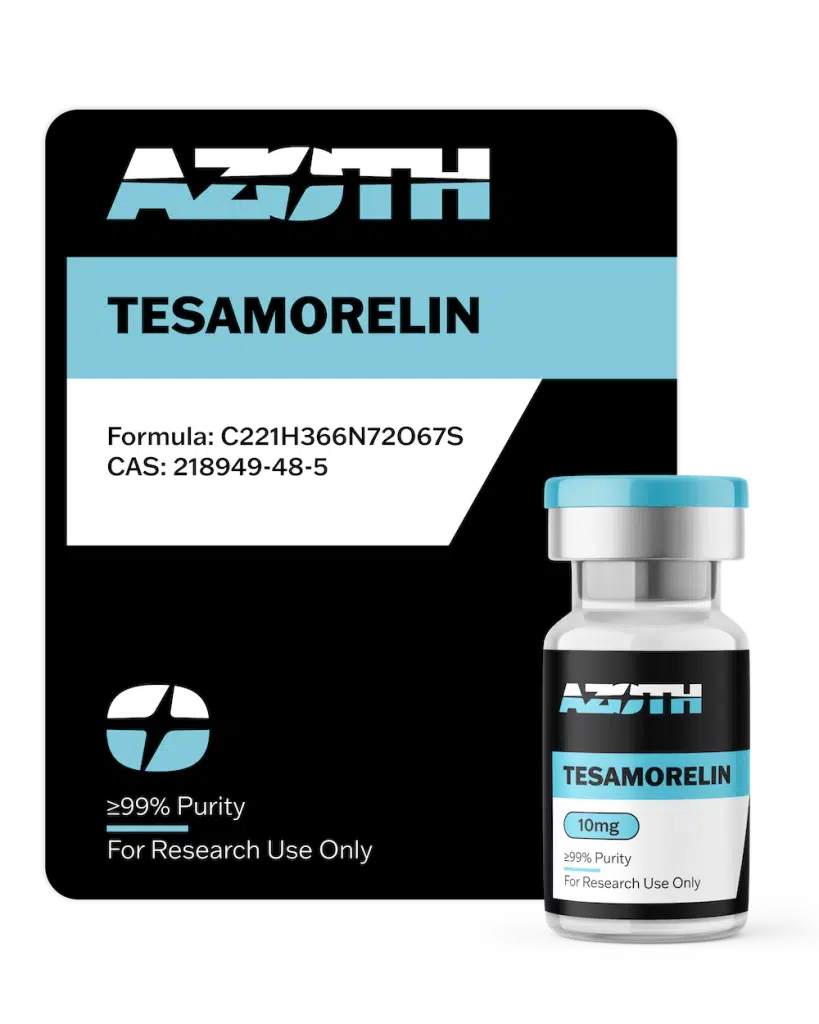
AZOTH supplies tesamorelin synthesized to 99%+ purity for licensed researchers and laboratory professionals. This material is intended exclusively for in vitro and laboratory research use.
How Does Tesamorelin Work? Several Mechanisms Studied
The research literature describes tesamorelin activity through several connected signaling pathways rather than a single isolated mechanism.
GHRH Receptor Binding and Pulsatile Signaling
Tesamorelin binds the GHRH receptor on anterior pituitary somatotroph cells, the same receptor engaged by native GHRH. Receptor binding initiates cyclic AMP accumulation and downstream signaling that governs growth hormone synthesis and release. Because the compound works through the physiological receptor pathway, research models using tesamorelin retain the pulse frequency and amplitude characteristics of native GH secretion, a design property that distinguishes GHRH analogue studies from studies administering recombinant growth hormone directly.
Structural Modification and Plasma Stability
Native GHRH is degraded quickly by dipeptidyl peptidase-4 at the N-terminus. The trans-3-hexenoyl group added to position one of the tesamorelin sequence limits this cleavage and extends circulating half-life. This structural feature is the basis for tesamorelin’s use in longer-duration study protocols where sustained receptor engagement is required.
IGF-1 Axis Activity
Growth hormone released downstream of GHRH receptor activation stimulates hepatic insulin-like growth factor 1 (IGF-1) production. Published research using tesamorelin has measured IGF-1 as a primary biochemical readout of GH axis engagement, and the GH/IGF-1 axis is the pathway through which most secondary research endpoints in this literature are interpreted.
Adipose Tissue Lipid Signaling
Growth hormone signaling influences hormone-sensitive lipase activity and lipolytic pathways within adipocytes, with reported differences between visceral and subcutaneous fat depots. This depot-specific signaling behavior is a recurring subject in tesamorelin research and is the mechanistic basis for the body composition endpoints reported across the published trial record.
Product Specifications
| Specification | Detail |
| Compound | Tesamorelin |
| Classification | GHRH(1-44) analogue, synthetic peptide |
| Amino Acid Count | 44 |
| CAS Number | 901758-09-6 |
| Molecular Formula | C223H370N72O69S |
| Molecular Weight | 5195.908 g/mol |
| PubChem CID | 44147413 |
| Purity | 99%+ verified by HPLC |
| Format | Lyophilized powder |
| Vial Size | 5mg |
| Origin | Manufactured in the USA |
| Documentation | Certificate of Analysis available per batch |
Sequence (Three Letter):
Tyr-Ala-Asp-Ala-Ile-Phe-Thr-Asn-Ser-Tyr-Arg-Lys-Val-Leu-Gly-Gln-Leu-Ser-Ala-Arg-Lys-Leu-Leu-Gln-Asp-Ile-Met-Ser-Arg-Gln-Gln-Gly-Glu-Ser-Asn-Gln-Glu-Arg-Gly-Ala-Arg-Ala-Arg-Leu, with a trans-3-hexenoyl group at the N-terminus.