
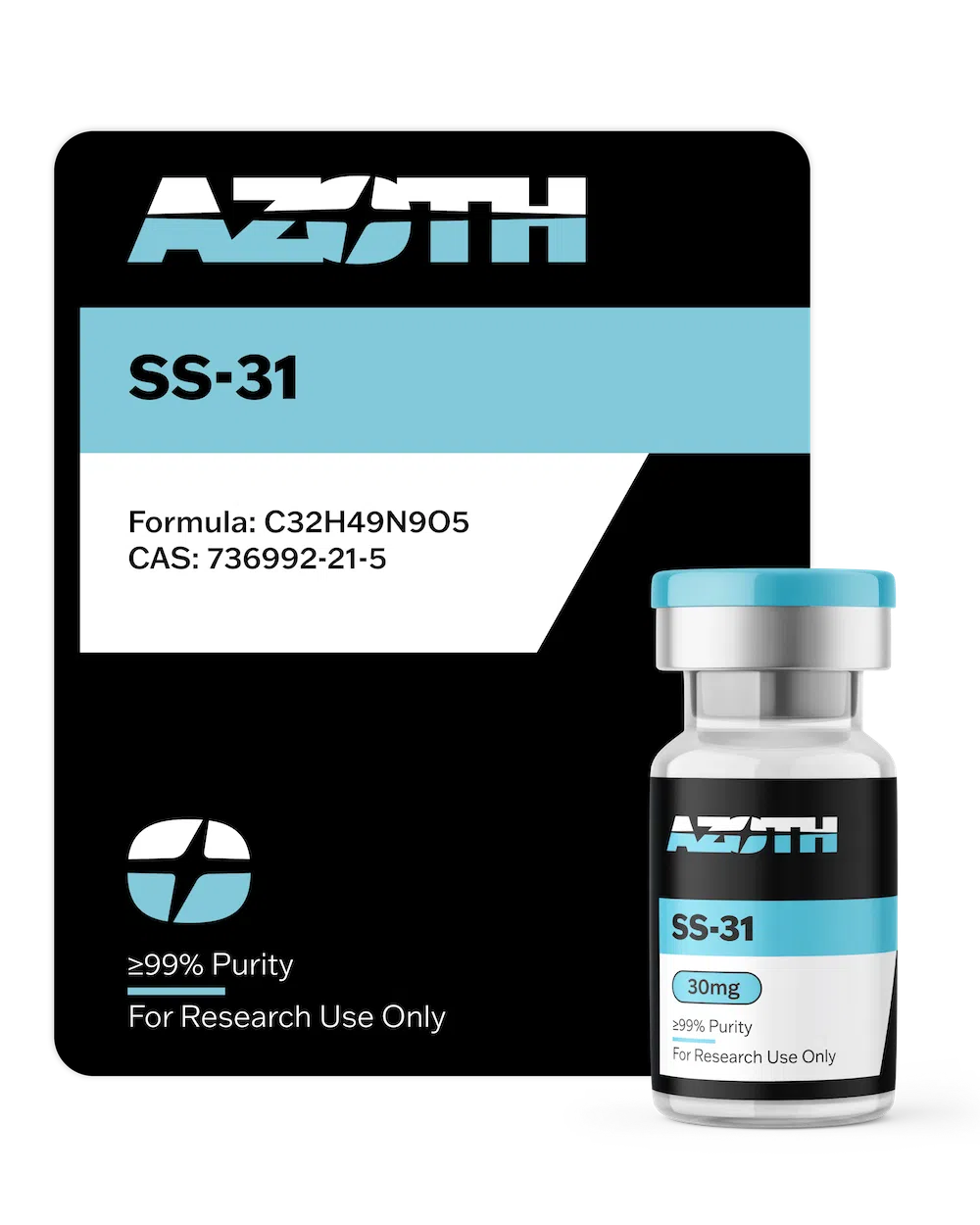

The SS-31 peptide is a research-use-only synthetic tetrapeptide (Szeto-Schiller peptide) supplied for qualified scientific, analytical, and non-clinical investigational applications. SS-31 is referenced extensively in the literature on mitochondrial bioenergetics, cardiolipin-associated pathway models, and redox research. This material is supplied strictly for laboratory research and is not for human or veterinary use, diagnostic use, therapeutic use, or personal use.
Molecular Reference Data
| Property | Value |
|---|---|
| Compound | SS-31 |
| Research Alias | Elamipretide / MTP-131 / Bendavia |
| CAS Number | 736992-21-5 |
| Molecular Formula | C₃₂H₄₉N₉O₅ |
| Molecular Weight | 639.8 g/mol |
| Sequence | D-Arg-Dmt-Lys-Phe-NH₂ (Dmt = 2′,6′-dimethyltyrosine) |
| PubChem CID | 11764719 |
| Purity | ≥99% |
| Format | Lyophilized powder, 30 mg / 50 mg, 3 mL vial |
| Storage | 2–8 °C |
| Research Category | Mitochondrial / Cellular Signaling Research |
What Is the SS-31 Peptide?
SS-31 is a small, cell-permeable aromatic-cationic tetrapeptide from the Szeto-Schiller family. Its defining property in the research literature is selective concentration at the inner mitochondrial membrane, where it binds directly to cardiolipin, a feature that makes it a widely used tool compound for studying mitochondrial function, membrane organization, and bioenergetics in isolated mitochondria and cell models. Preclinical studies across multiple experimental models have examined how this binding relationship influences cellular energy production, oxidative phosphorylation, and mitochondrial dynamics.
Mechanism of Action: Cardiolipin Binding and Mitochondrial Bioenergetics
In the published literature, SS-31 specifically targets cardiolipin, an anionic phospholipid expressed exclusively on the inner mitochondrial membrane and required for cristae formation and for organizing the respiratory complexes into supercomplexes. By associating with cardiolipin through electrostatic and hydrophobic interactions, SS-31 has been reported to preserve cristae architecture and stabilize respiratory-chain organization, supporting electron transport chain efficiency and optimal mitochondrial function through oxidative phosphorylation.
A related mechanism involves cytochrome c: the SS-31/cardiolipin interaction has been shown to inhibit cytochrome c peroxidase activity, the reaction that drives cardiolipin peroxidation and mitochondrial membrane damage during ischemic stress (Birk et al., 2013). By limiting cardiolipin peroxidation and electron leak, SS-31 is described in the literature as reducing reactive oxygen species (ROS) generation indirectly, through membrane stabilization rather than direct free-radical scavenging, thereby reducing oxidative stress and oxidative damage at the mitochondrial level. This preservation of membrane potential and mitochondrial membrane potential is understood as the basis of the compound’s reported effects on ATP production and cellular energy in experimental models.
Preclinical Research Findings
The findings below are drawn from peer-reviewed in-vitro and animal studies. They describe observations reported in the scientific literature and are not claims about this product or about any human or veterinary use.
Ischemia-reperfusion and kidney models: In rat models of renal ischemia-reperfusion injury, SS-31 was associated with protection of cristae membranes, accelerated ATP recovery on reperfusion, and reduced cell death (Szeto et al., 2011; Birk et al., 2013). The protective effects observed in these models are attributed to SS-31’s ability to preserve mitochondrial structure and support ATP synthesis during and after ischemic stress.
Aged skeletal muscle: In aged mice, SS-31 was reported to rapidly improve mitochondrial efficiency and skeletal muscle parameters relative to controls (Siegel et al., 2013), a model used to study age-related mitochondrial decline. Energy production in skeletal muscle is closely tied to normal mitochondria function, making this an active area of mitochondrial peptide research.
Cardiac models / ex-vivo human tissue: In failing human heart tissue studied ex vivo, SS-31 (elamipretide) was associated with improvements in mitochondrial oxygen flux and adenosine triphosphate synthesis-related activity (Chatfield et al., 2019). This is consistent with a broader body of preclinical evidence examining how mitochondrial stress and impaired cellular energy output contribute to cardiac dysfunction.
Genetic-disorder models: In tafazzin-knockdown models of Barth syndrome, an X-linked genetic disorder of cardiolipin remodeling, SS-31 has been studied for effects on mitochondrial respiration, respiratory chain organization, and mitochondrial dynamics (Szeto, 2014). Barth syndrome research has been central to understanding how cardiolipin-targeted compounds interact with cell membrane architecture and mitochondrial function.
Neurodegenerative and neural tissue models: Research has examined SS-31 in neurodegenerative diseases and neural tissue contexts where mitochondrial dysfunction is implicated as a contributor to disease pathology. These experimental models are used to characterize peptide behavior in cell type-specific mitochondrial environments.
Chronic kidney disease and kidney disease models: SS-31 has been studied in chronic kidney disease contexts where mitochondrial dysfunction is understood as a factor in progressive renal injury. Clinical trials and preclinical studies have both examined markers of mitochondrial respiration and energy production in kidney models.
Research Areas Referenced in the Literature
SS-31 has been examined across multiple research domains tied to mitochondrial dysfunction and bioenergetics, including primary mitochondrial myopathy, chronic kidney disease, cardiac function in ischemic models, and neurodegenerative-disease and neural tissue research. These are clinical applications and research directions described by authors in the primary literature and do not represent approved uses of this research material or any indication of efficacy for human or veterinary application.
Barth Syndrome and Primary Mitochondrial Myopathy
Barth syndrome and primary mitochondrial myopathy are the indications in which the molecule advanced furthest in clinical investigation. The phase 2/3 TAZPOWER program and the MMPOWER dose-escalation work (Karaa et al., 2018) are the principal clinical trials references; investigators reported measures spanning cardiac parameters and muscle strength in the Barth syndrome program.
Regulatory Status
The molecule elamipretide received FDA accelerated approval on September 19, 2025, marketed as Forzinity (elamipretide HCl injection), indicated to improve muscle strength in adult and pediatric Barth syndrome patients weighing at least 30 kg. This is a narrow, ultra-rare indication approved as a prescription injectable on an intermediate clinical endpoint, with continued approval contingent on a confirmatory trial.
This is an essential distinction for research use: the RUO material supplied here is not the FDA-approved Forzinity drug product and is not approved for any use in this form. It is supplied solely for laboratory research and is not for human or veterinary use. Researchers should confirm the regulatory, import, and institutional-handling requirements applicable in their own jurisdiction before acquiring or working with this compound.
Analytical Characterization
SS-31 is characterized using standard peptide-analytical methods, including reverse-phase HPLC for purity, mass spectrometry for identity and molecular-weight confirmation, and supporting techniques such as western blotting in downstream cell models. Identity and purity verification supports reproducibility across assay development, formulation research, and comparative peptide evaluation.
Research and Safety Considerations
This is an investigational research material characterized primarily through in-vitro and animal-model work, supplied for qualified laboratory settings only. It should be handled according to established institutional procedures for research peptides. Material obtained outside characterized, quality-controlled supply chains may carry identity and purity risks. Nothing on this page should be interpreted as guidance for use in humans or animals.
Sourcing and Quality
AZOTH supplies this research material at ≥99% purity, lyophilized, with batch documentation available via the published Certificate of Analysis. Sourcing from a characterized, quality-controlled process is the recommended basis for any defensible research program.
Storage
Store lyophilized material at 2–8 °C, protected from light and moisture; -20 °C is appropriate for extended storage. Follow established internal handling procedures for reconstitution and aliquoting.
Key Takeaways
- SS-31 is a synthetic Szeto-Schiller tetrapeptide (D-Arg-Dmt-Lys-Phe-NH₂; CAS 736992-21-5; C₃₂H₄₉N₉O₅; 639.8 g/mol) used in mitochondrial bioenergetics research.
- Its characterized mechanism is high-affinity binding to cardiolipin on the inner mitochondrial membrane, stabilizing cristae and respiratory-chain organization and limiting cytochrome c-driven cardiolipin peroxidation and ROS generation.
- Preclinical literature spans ischemia-reperfusion, kidney, aged skeletal muscle, cardiac, and genetic-disorder (Barth syndrome) models.
- The molecule was FDA-approved as Forzinity (elamipretide) for Barth syndrome in September 2025; this RUO research material is a distinct, unapproved research compound supplied for laboratory use only.
FAQ
Is SS-31 the same as elamipretide? SS-31 is the research designation for the tetrapeptide also known as elamipretide (MTP-131, Bendavia). The FDA-approved drug product of this molecule is marketed as Forzinity; the RUO material supplied here is not that drug product.
What research category does SS-31 fall under? It is referenced primarily in mitochondrial and cellular-signaling research, including cardiolipin-pathway, redox, and mitochondrial membrane model studies.
Is SS-31 approved for human use? The molecule elamipretide is FDA-approved as Forzinity for one ultra-rare indication (Barth syndrome) as a prescription injectable. This research material is not that approved product and is supplied for laboratory research use only, not for human or veterinary use.
How should SS-31 be stored? Lyophilized material is stable at 2–8 °C short-term and -20 °C for longer storage, protected from light and moisture.
Research Use Only — Disclaimer
All information provided is for informational and educational purposes only and does not constitute medical advice and should not be considered medical advice. SS-31 is supplied solely for laboratory, analytical, and scientific research by qualified research accounts. It is not for human consumption, human use, veterinary use, diagnostic use, therapeutic use, or administration of any kind. Statements on this page have not been evaluated by the FDA, and this research material is not intended to diagnose, treat, cure, or prevent any disease. AZOTH is not a compounding pharmacy or outsourcing facility.
References
- Birk AV, Liu S, Soong Y, et al. The mitochondrial-targeted compound SS-31 re-energizes ischemic mitochondria by interacting with cardiolipin. J Am Soc Nephrol. 2013;24(8):1250–1261. https://pubmed.ncbi.nlm.nih.gov/23813215/
- Szeto HH, et al. Mitochondria-targeted peptide accelerates ATP recovery and reduces ischemic kidney injury. J Am Soc Nephrol. 2011;22(6):1041–1052. https://doi.org/10.1681/ASN.2010080808
- Siegel MP, et al. Mitochondrial targeted peptide rapidly improves mitochondrial energetics and skeletal muscle performance in aged mice. Aging Cell. 2013;12(5):763–771. https://doi.org/10.1111/acel.12102
- Chatfield KC, et al. Elamipretide improves mitochondrial function in the failing human heart. JACC Basic Transl Sci. 2019;4(2):147–157. https://doi.org/10.1016/j.jacbts.2018.12.005
- Karaa A, Haas R, Goldstein A, et al. Randomized dose-escalation trial of elamipretide in adults with primary mitochondrial myopathy. Neurology. 2018;90(14):e1212–e1221. https://doi.org/10.1212/WNL.0000000000005255
- Szeto HH. First-in-class cardiolipin-protective compound as a therapeutic agent to restore mitochondrial bioenergetics. Br J Pharmacol. 2014;171(8):2029–2050. https://doi.org/10.1111/bph.12461
- U.S. Food and Drug Administration. FDA Grants Accelerated Approval to First Treatment for Barth Syndrome. September 19, 2025. https://www.fda.gov/news-events/press-announcements/fda-grants-accelerated-approval-first-treatment-barth-syndrome
- PubChem. Elamipretide (CID 11764719). National Library of Medicine. https://pubchem.ncbi.nlm.nih.gov/compound/11764719


