
- For research purpose only
- Made in the USA
- Major Credit Cards Accepted
- Third Party Tested
- For research purpose only
- Made in the USA
- Major Credit Cards Accepted
- Third Party Tested
- For research purpose only
- Made in the USA
- Major Credit Cards Accepted
- Third Party Tested
- For research purpose only
- Made in the USA
- Major Credit Cards Accepted
- Third Party Tested
- Home
- /
- Neuroprotective Research
- /
- Pinealon 20mg
SKU
AZ-PINEALON-10
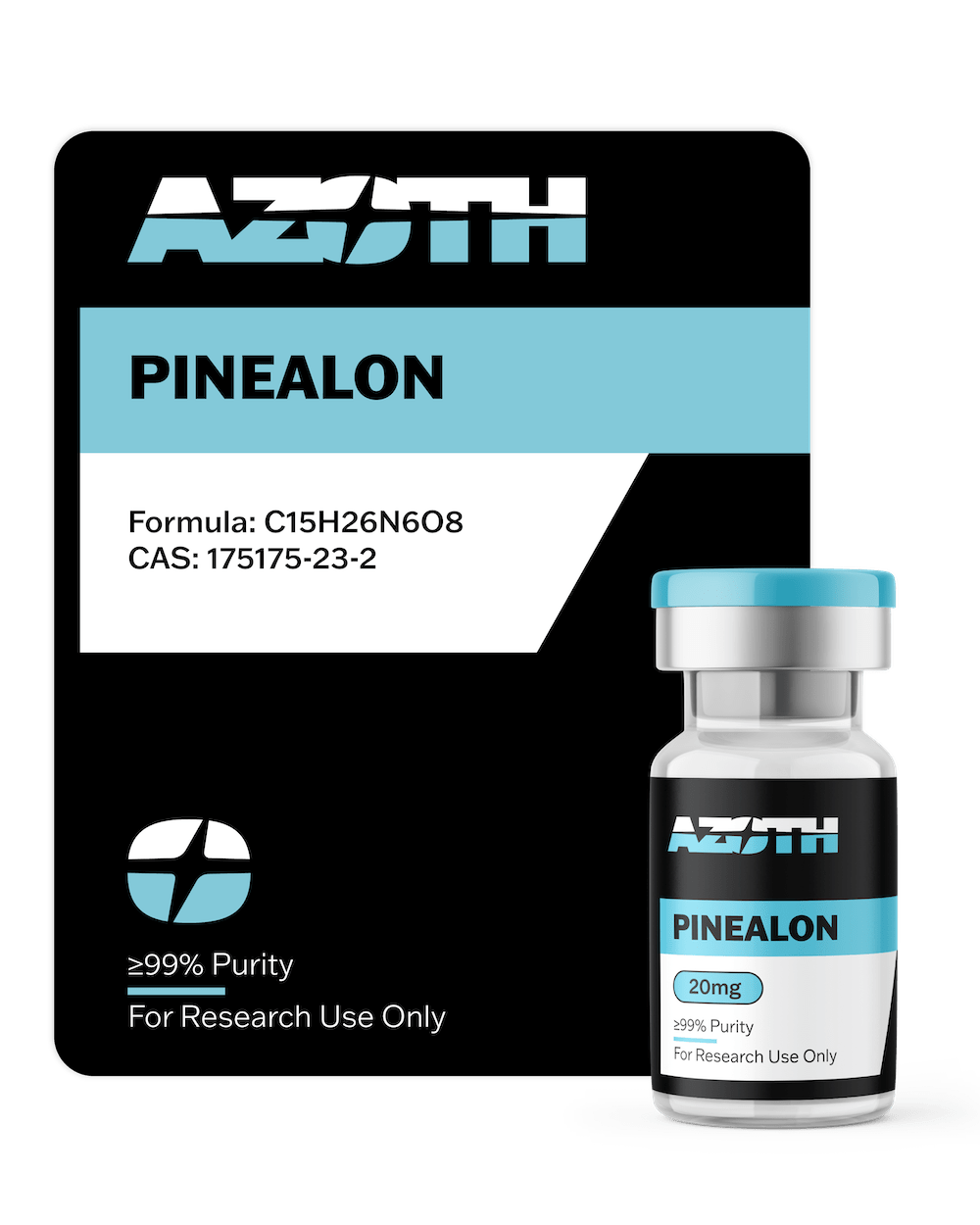
Pinealon 20mg
Pricing
In stock
Fulfillment Timing Based on Inventory and Account Status.
Pinealon 20mg
HPLC Certified
CAS #
175175-23-2
M.W.
350.4
Formula
C15H26N6O8
- PURITY
- ≥99%
RUO
- (Research Use Only)
Specs:
- Amount: 20mg | Format: Lyophilized Powder | Container: 3mL Vial | Storage: 2-8°C | Type: Single Peptide | Research Alias: Pinealon / EDR | Research Category: Short Peptide Research
<h2″>What Is Pinealon?
Pinealon is a synthetic tripeptide composed of three amino acids: glutamic acid, aspartic acid, and arginine, often abbreviated as EDR based on its sequence. It belongs to a family of short peptide bioregulators originally developed by Professor Vladimir Khavinson and colleagues at the St. Petersburg Institute of Bioregulation and Gerontology in Russia. Pinealon was designed to model peptide activity naturally present in the pineal gland, and much of the published research on this compound comes from that same research group. At AZOTH, we supply Pinealon synthesized to strict purity standards, intended exclusively for licensed researchers and laboratory professionals working in laboratory research settings.
How Was Pinealon Developed?
Pinealon sits within a broader category of Khavinson-family short peptide bioregulators, alongside compounds such as Epitalon and Cortexin, each associated with different tissue targets. While Epitalon research has focused heavily on telomerase-related pathways, Pinealon research has concentrated on neuronal gene expression, circadian rhythm regulation, and pineal gland and hypothalamic tissue activity in preclinical models. Foundational data exists in a 2011 in vitro study published in Rejuvenation Research, along with related papers examining protein synthesis regulation and cell viability in cultured neuronal tissue.
Proposed Mechanism of Action
Preclinical studies propose that Pinealon may act as a DNA-binding peptide, interacting with promoter regions to help regulate gene expression relevant to neuronal function. This mechanism, sometimes described as peptide correction, is hypothesized to influence protein synthesis regulation in brain cortex cells and other central nervous system tissue. Researchers investigating short peptides in this class have observed effects on reactive oxygen species accumulation and free radical levels in cell culture models, with some studies reporting that Pinealon increases cell viability in models using brain cortex cells, HeLa cells, and skin cells. A 2020 mechanistic review in PMC further describes proposed pathways connecting EDR peptide activity to activating proliferative processes at the cellular level.
Regulatory Status
Pinealon has no established regulatory classification in the United States and is not FDA-approved for any human therapeutic use. No Phase 1 human safety study evaluating Pinealon has been published, and the human side effect profile of this compound is unknown. As of 2026, no completed randomized controlled trials in humans have been documented for Pinealon, and products sold online outside controlled laboratory conditions may carry contamination risks. Pinealon remains classified strictly as a research peptide and investigational compound, and it is not available through licensed U.S. compounding pharmacies. AZOTH sells Pinealon exclusively for laboratory and in vitro research use, consistent with its regulatory status as an unapproved research compound.
Related
Neuroprotection Research
A substantial portion of Pinealon literature examines neuroprotective properties observed in animal models and cultured neurons. Research published by Arutjunyan and colleagues studied Pinealon administration in rat offspring exposed to prenatal hyperhomocysteinemia, reporting improvements in cognitive function measures within that experimental model. Related studies have investigated Pinealon’s role in protecting brain tissue against oxidative stress, examining reactive oxygen species accumulation in brain cortex cells under laboratory conditions. Some research groups have also modeled Pinealon exposure in the context of carotid artery occlusion, a method used to simulate sharp hypoxic hypoxia and observe subsequent effects on neuronal resistance in animal models.
Circadian Rhythm and Sleep-Related Research
Because Pinealon research originated from work on the pineal gland, a structure central to circadian rhythm regulation, several studies have modeled its effects on sleep-wake cycle parameters in aged animal subjects. Investigators have compared outcomes between young and old rats, reporting that evening administration in these models was associated with measurable changes in sleep pattern metrics within the constraints of the study design. This research area remains preclinical, and any observations regarding sleep quality or circadian rhythm regulation are limited to the animal and in vitro models described in the published literature, not established clinical outcomes.
Cognitive Function and Aging Models
Research on organic brain syndrome and neurological aging models has explored whether Pinealon administration correlates with changes in cognitive function markers in aged rat subjects, sometimes described in the literature as models of cognitive decline. A mechanistic review by Khavinson and colleagues describes oral administration studies in older age groups within the animal literature, examining effects tied to what researchers term chronic polymorbidity models. These studies remain confined to animal and cell-based research and have not been replicated in independent, large-scale human clinical trials.
Gene Expression and Cellular Research
Because Pinealon is hypothesized to interact with DNA promoter regions, a meaningful share of published research investigates its role in regulating gene expression across different cell types, including studies using short fluorescence labeled peptides to trace vitro specific interaction with nuclear material. Some studies report that Pinealon may increase serotonin expression by modulating tryptophan hydroxylase gene activity, though this remains an early-stage area of investigation limited to cell culture and animal model contexts. Related work has also examined blood serum markers following subcutaneous injection protocols in rodent studies, again strictly within preclinical settings.
What the Preclinical Science Shows
The body of Pinealon research is comparatively narrow relative to more widely studied peptides, and researchers note that much of the literature originates from a single research group in Russia, with limited independent replication in Western clinical and experimental medicine journals. Below is a summary of key preclinical research areas documented in the published literature.[peptidehelper]
| Research Area | Model | Key Findings |
|---|---|---|
| Neuroprotection | Rat brain cortex cell models | Reduced reactive oxygen species accumulation and modulated caspase-3 activity reported in cultured neuronal tissue |
| Prenatal Cognitive Development | Rat offspring, prenatal hyperhomocysteinemia model | Improved cognitive function measures reported in treated rat offspring |
| Circadian Rhythm Regulation | Young and old rat models | Changes in sleep-wake cycle parameters observed following evening administration |
| Gene Expression | HeLa cells, brain cortex cells, skin cells | Increased cell viability and activating proliferative processes reported across multiple cell types |
| Hypoxic Stress Resistance | Carotid artery occlusion rat models | Enhanced neuronal resistance to hypoxic stress reported in preclinical models |
| Aging and Organic Brain Syndrome | Aged rat models | Correction of cerebral dysfunction markers reported in older-age animal cohorts |
No large-scale, independent randomized controlled trials in humans have been published for Pinealon as of 2026, and the compound’s human safety and side effect profile remain undocumented in peer-reviewed literature. Larger, well-controlled human studies conducted outside the originating research group would be necessary before any conclusions about human safety or efficacy could be drawn.
Why Researchers Choose AZOTH for Pinealon Peptide
Scientific rigor and product consistency are essential in laboratory research involving investigational peptides like Pinealon. AZOTH provides Pinealon manufactured to strict purity specifications, backed by third-party certificate of analysis documentation for each batch.
- Verified 99%+ purity via HPLC testing
- USA-manufactured under strict quality protocols
- Third-party tested for identity, purity, and stability
- Lyophilized powder format for maximum shelf stability
- Certificate of Analysis available for every batch
Whether your focus is gene expression pathways, circadian rhythm modeling, or neuroprotection mechanisms in animal models, AZOTH provides the compound quality your laboratory research demands, serving researchers and science-focused customers across the peptide research community.
Storage and Handling
Pinealon is supplied in lyophilized (freeze-dried) powder form. Store at 2 to 8 degrees C in a cool, dry environment away from direct light and moisture. After reconstitution with bacteriostatic water, keep refrigerated and use in accordance with your laboratory research protocol.
Legal Disclaimer
Pinealon sold by AZOTH is intended for laboratory and in vitro research use only. It is not approved by the Food and Drug Administration (FDA) for human consumption, medical use, diagnostic procedures, or veterinary use. This product has not been evaluated by the FDA and is not intended to diagnose, treat, cure, or prevent any disease or medical condition. Bodily introduction of any kind into humans or animals is strictly prohibited by law. All purchasers must be licensed researchers or qualified laboratory professionals. By purchasing this product, you acknowledge that you are aware of the applicable regulations in your jurisdiction and that you will use this compound exclusively within a qualified research environment.
| Research Findings | Journal | Data | Source Link |
|---|---|---|---|
| 1. Arutjunyan A, et al. “Pinealon protects the rat offspring from prenatal hyperhomocysteinemia.” | Int J Clin Exp Med | 2012 | https://pmc.ncbi.nlm.nih.gov/articles/PMC3342713/ |
| 2. Khavinson VK, et al. “EDR Peptide: Possible Mechanism of Gene Expression and Protein Synthesis Regulation.” | PMC | 2020 | https://pmc.ncbi.nlm.nih.gov/articles/PMC7795577/ |
| 3. Corepeptides research review. “Pinealon Peptide: Research on Neuroprotection, Cell Vitality, and Cellular Age-Related Processes.” | Corepeptides | 2024 | https://www.corepeptides.com/pinealon-peptide-research-on-neuroprotection-cell-vitality-and-cellular-age-related-processes/ |
| 4. Clinical Peptide Library. “Pinealon: Research Overview, Mechanism & Molecular Data.” | Clinical Peptide | 2026 | https://clinicalpeptide.org/library/pinealon/ |
| 5. PeptideHelper. “Pinealon, Khavinson short peptide bioregulator.” | PeptideHelper.org | 2026 | https://peptidehelper.org/peptide/pinealon/ |
| 6. Superpower Guides. “Pinealon (EDR): A Khavinson-Group Tripeptide in Preclinical Research.” | Superpower | 2026 | https://superpower.com/guides/pinealon |
Featured Research Compounds

Research use only
All AZOTH products are intended solely for laboratory research, analytical, and scientific use. Products are not for human consumption, human use, veterinary use, diagnostic use, therapeutic use, or administration of any kind.