Third-Party Tested
Independent Lab Review
Per-Batch COA
Lot-Specific Documentation
≥99% Purity
Research-Grade Standard
COA Verified
Chromatography + ILS Supported
SKU
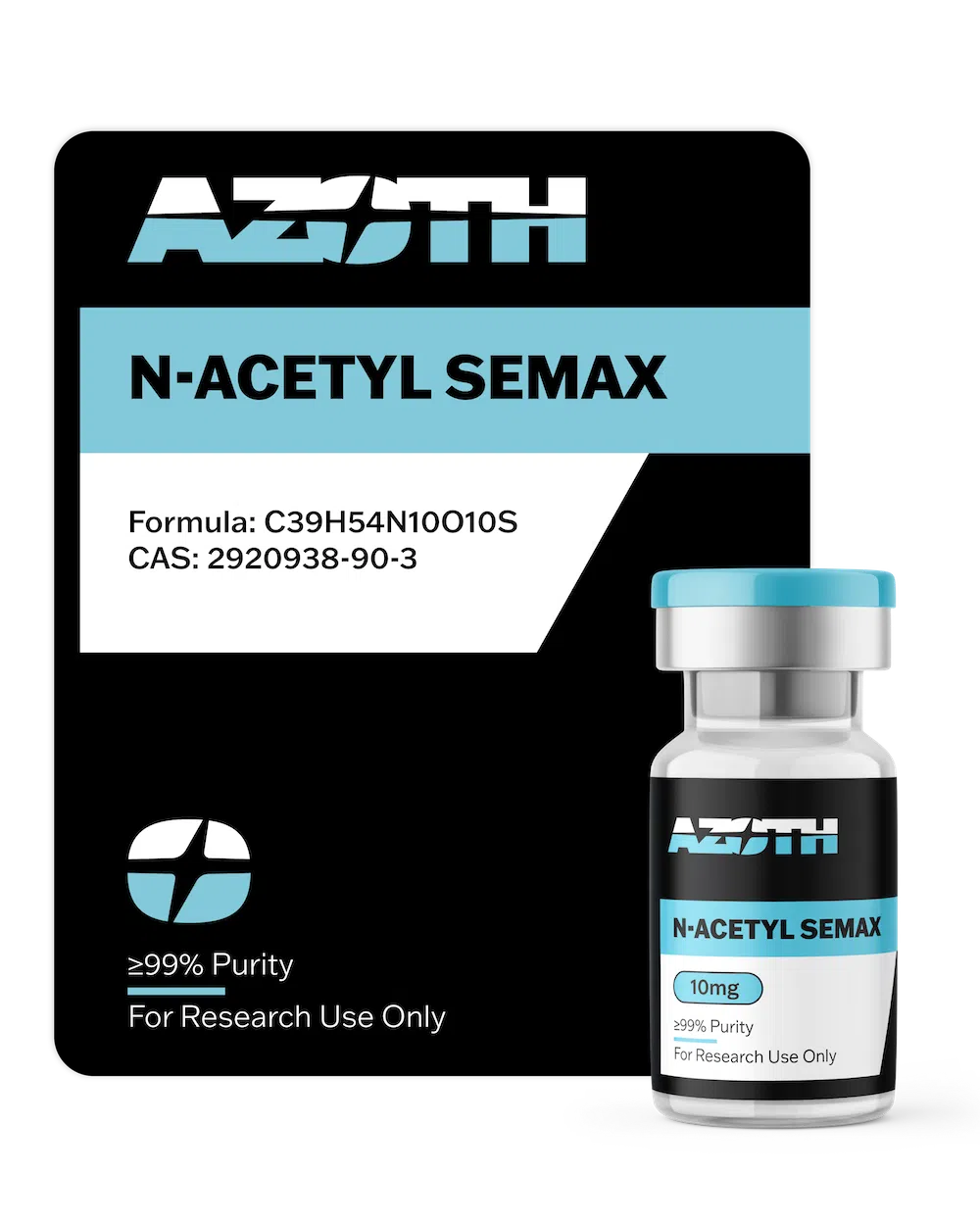
AZ-NASEMAX-10

N-Acetyl Semax

Third-Party Tested
Per-Batch COA
HPLC Verified
≥99% Purity
Pricing

In stock

Fulfillment Timing Based on Inventory and Account Status.

N-Acetyl Semax
HPLC Certified
CAS #
2920938-90-3
M.W.
854.9
Formula
C39H54N10O10S
RUO
Specs:

What Is N-Acetyl Semax?

N-Acetyl Semax is a synthetic derivative of the heptapeptide Semax, a compound first developed in Russia as an analog of the adrenocorticotropic hormone fragment ACTH(4-10). N-Acetyl Semax Amidate carries an acetyl group at the N-terminus and an amide modification at the C-terminus, changes that give the molecule a molecular weight of 855.95 g/mol and improved resistance to enzymatic breakdown. Researchers studying this acetylated form are primarily interested in how the added stability affects the compound’s behavior in experimental models compared to the parent Semax peptide. There is no FDA-approved Semax product in the United States, and N-Acetyl Semax is sold exclusively for laboratory and in vitro research use. At Azoth, this compound is produced under strict quality protocols and shipped only to qualified researchers and laboratory professionals.

The Structure Behind N-Acetyl Semax Amidate

Semax itself consists of the sequence Met-Glu-His-Phe-Pro-Gly-Pro, built around a Pro-Gly-Pro motif at the C-terminus that researchers have linked to some of the peptide’s observed effects in the central nervous system. Acetylation at the N-terminus is the modification that separates N-Acetyl Semax Amidate from standard Semax, and current evidence on this acetylated analog is drawn largely from studies conducted on the parent compound rather than dedicated trials on the acetylated version itself. This distinction matters for anyone reviewing scientific literature on the topic, since much of what is published applies to Semax broadly rather than to N-Acetyl Semax Amidate specifically.

How Does Semax Peptide Research Explain Observed Effects?

Semax peptide research points to a mechanism that does not rely on classic hormonal signaling, despite the compound’s structural relationship to ACTH. Semax lacks significant hormonal activity even though it is derived from adrenocorticotropic hormone, and researchers instead focus on its role in enkephalin regulation and neurotrophic signaling. Semax inhibits enkephalin-degrading enzymes, which raises enkephalin levels and is one of the proposed explanations for effects observed in experimental models.

Brain Derived Neurotrophic Factor and TrkB Expression

One of the most cited findings in Semax research involves brain derived neurotrophic factor signaling in the rat hippocampus. A single intranasal application of Semax produced a 1.4-fold increase in BDNF protein and a 1.6-fold increase in TrkB tyrosine phosphorylation, alongside a 3-fold rise in exon III BDNF mRNA and a 2-fold rise in TrkB mRNA. Researchers studying these outcomes have proposed that Semax regulates BDNF and TrkB expression through a hippocampal signaling pathway connected to memory formation in animal models.

Serotoninergic Brain Systems and Dopaminergic Activity

Semax exposure has been shown to influence serotoninergic brain systems in rodent studies. Using brain microdialysis, researchers observed increased extracellular 5-HIAA, a serotonin metabolite, in the striatum of freely moving rats, with reports of a 180% increase in 5-HIAA levels four hours after administration. Semax does not appear to alter dopamine levels directly on its own, but experimental models suggest it may enhance responsiveness to dopaminergic modulators, a finding that has drawn interest from researchers examining attention and psychostimulant interactions.

Research Applications for N-Acetyl Semax

Laboratories exploring N-Acetyl Semax typically approach the compound through the lens of neurotrophic signaling, behavioral testing, and central nervous system research in animal models. The sections below outline the primary research areas connected to Semax and its acetylated analog.

Cognitive and Behavioral Research

Semax has a long research history tied to nootropic properties in white rats, with studies examining conditioned avoidance reactions and selective attention under stress. Semax exposure has been shown to improve attention in experimental models placed under stress conditions, and researchers have proposed that this stems from combined effects on neurotrophin expression and neurotransmitter systems. N-Acetyl Semax Amidate is of interest to this research area because acetylation may extend the compound’s presence in circulation, a property researchers are still working to characterize.

Neuroprotective and Ischemia Research

Semax and its C-terminal Pro-Gly-Pro fragment have been studied in models of cerebral ischemia, where treatment affected neurotrophin and receptor gene expression in the frontal cortex and hippocampus of ischemized rats. Researchers have observed protective effects on gene expression patterns disrupted by oxygen deprivation, with the strongest effects reported in the hippocampus roughly 12 hours after occlusion.

Behavioural and Neurochemical Alterations Research

Some researchers have investigated how peptide exposure interacts with early life fluvoxamine exposure and other pharmacological interventions in rodent models, looking at whether Semax attenuates behavioural and neurochemical alterations produced by these exposures. This line of research treats Semax as a tool for probing how neurotransmitter systems recover or adapt following early developmental disruption, rather than as a standalone treatment.

Comparisons With Selank and Other Analogs

Selank, another ACTH-derived peptide developed alongside Semax, is frequently referenced in the same body of scientific literature because it inhibits similar enzyme pathways and shares research applications tied to central nervous system signaling. Researchers evaluating N-Acetyl Semax often reference Selank inhibit studies for context when designing comparative experimental models.

Research Summary: What Semax Studies Show

Because dedicated studies on N-Acetyl Semax Amidate are limited, most of what is known comes from research on the parent Semax peptide. The table below summarizes key findings from published animal model research.

Research Area Model Key Findings
BDNF/TrkB Signaling Rat hippocampus 1.4-fold BDNF protein increase, 3-fold exon III BDNF mRNA increase after a single dose
Serotonin Metabolism Rat striatum, microdialysis 180% increase in 5-HIAA levels 4 hours post-exposure
Cerebral Ischemia Rat carotid occlusion model Altered neurotrophin and TrkB mRNA expression in frontal cortex and hippocampus
Attention and Behavior White rats under stress Improved attention performance in experimental stress models
Enzyme Interaction In vitro and rat models Inhibition of enkephalin-degrading enzymes, raising enkephalin levels

N-Acetyl Semax Amidate has a plausible biological mechanism based on this parent compound data, but it lacks extensive clinical studies of its own. Researchers such as Zozulia AA, Kamensky AA, Levitskaya NG, and Andreeva LA have contributed to the body of work on Semax’s effects on neurotrophic and enkephalin pathways, and their studies remain the primary reference point for anyone reviewing this compound.

Why Researchers Choose Azoth for N-Acetyl Semax

Consistency between batches matters when comparing results across experiments. Azoth manufactures N-Acetyl Semax in the USA and verifies each batch through third-party testing.

  • Verified 99% purity via HPLC testing
  • USA-manufactured under strict quality protocols
  • Third-party tested for identity, purity, and stability
  • Lyophilized powder format for shelf stability
  • Certificate of Analysis available for every batch

Storage and Handling

N-Acetyl Semax ships as a lyophilized powder. Store at 2-8°C in a cool, dry space away from light and moisture. After reconstitution with bacteriostatic water, keep the vial refrigerated and follow your laboratory’s protocol for handling and disposal.

Legal Disclaimer

N-Acetyl Semax sold by Azoth is intended for laboratory and in vitro research use only. It is not approved by the Food and Drug Administration for human consumption, medical use, diagnostic procedures, or veterinary use. This product has not been evaluated by the FDA and is not intended to diagnose, treat, cure, or prevent any disease. Introduction of this compound into humans or animals is strictly prohibited by law. All purchasers must confirm they are licensed researchers or qualified laboratory professionals operating within a compliant research environment.

Research Findings Journal Data Source Link
1. Dolotov OV, et al. “Semax, an analog of ACTH(4-10) with cognitive effects, regulates BDNF and trkB expression in the rat hippocampus.” Brain Res. 2006; 1117(1):54-60 https://pubmed.ncbi.nlm.nih.gov/16996037/ 
2. Semax and trkB expression review. ScienceDirect 2006 https://www.sciencedirect.com/science/article/pii/S0006899306022955 
8. Semax and dopaminergic/serotoninergic systems review. ScienceDirect 2006 https://www.sciencedirect.com/science/article/abs/pii/S0006899306022955 
11. Stavchansky VV, et al. “Effect of semax and its C-terminal peptide PGP on expression of neurotrophins and their receptors in rat brain during incomplete global ischemia.” Mol Biol 2011; 45:941-949 https://link.springer.com/article/10.1134/S0026893311050128 
16. Effects of Semax on Dopaminergic and Serotoninergic Systems study. Paulina Medical Clinic archive n.d. https://www.paulinamedicalclinic.com 
25. Dolotov OV, et al. “The heptapeptide SEMAX stimulates BDNF expression in different areas of the rat brain in vivo.” Neurosci Behav Physiol 2003; 391:292-5 https://pubmed.ncbi.nlm.nih.gov/14556513/ 
Research use only

All AZOTH products are intended solely for laboratory research, analytical, and scientific use. Products are not for human consumption, human use, veterinary use, diagnostic use, therapeutic use, or administration of any kind.