Third-Party Tested
Independent Lab Review
Per-Batch COA
Lot-Specific Documentation
≥99% Purity
Research-Grade Standard
COA Verified
Chromatography + ILS Supported
SKU
AZ-KPV-10 / AZ-KPV-30

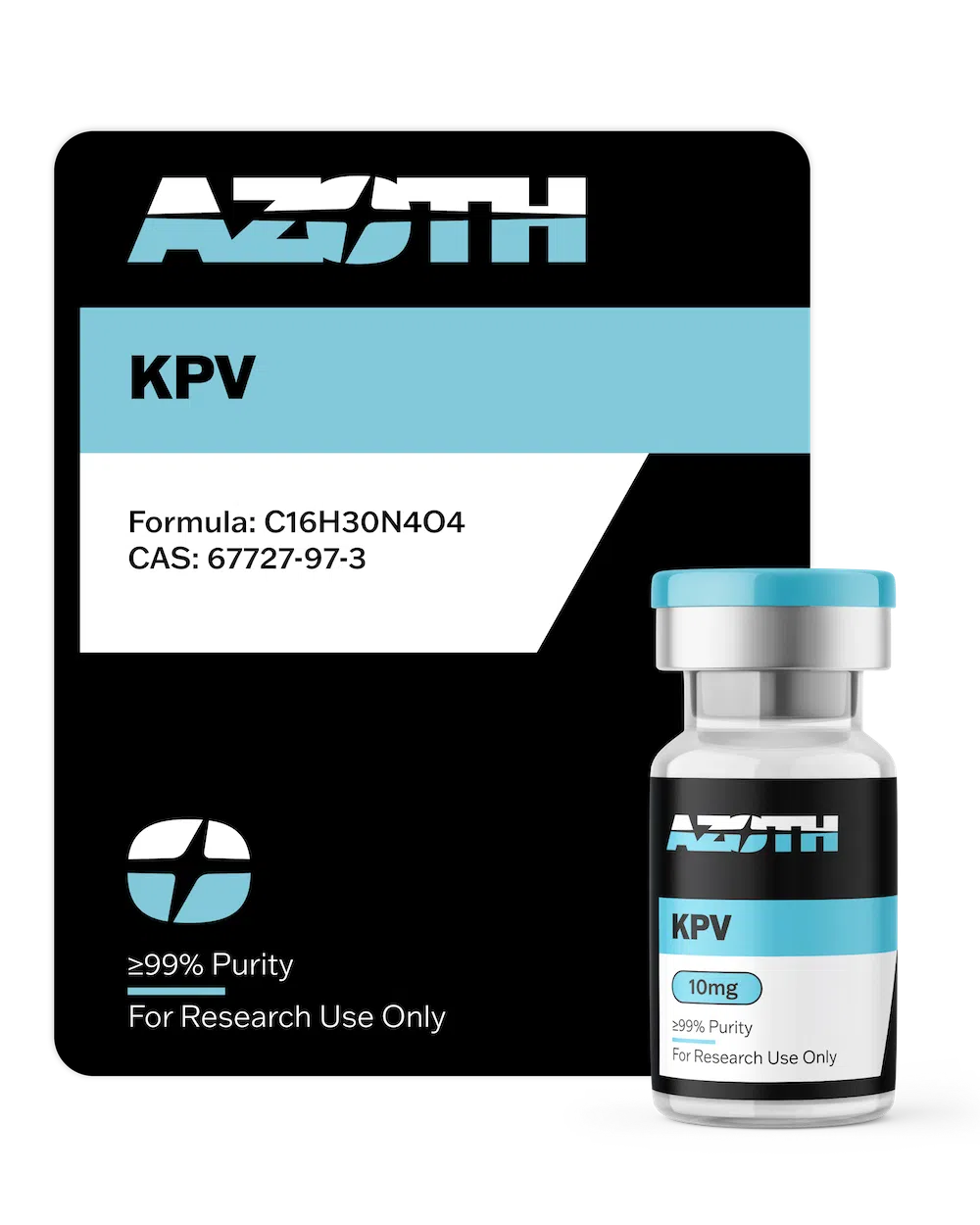
KPV

Third-Party Tested
Per-Batch COA
HPLC Verified
≥99% Purity
Pricing


You save (%)

Fulfillment Timing Based on Inventory and Account Status.

KPV
HPLC Certified
CAS #
67727-97-3
M.W.
342.43
Formula
C17H27N5O4
RUO
Specs:

KPV Peptide | Tripeptide for Gut Health Research | Azoth

What Is the KPV Peptide?

KPV peptide is a small fragment derived from the C-terminal tail of alpha-melanocyte-stimulating hormone, and it has become a focal point for researchers studying inflammation and gut health. This tripeptide is composed of just three amino acids, lysine, proline, and valine, giving it a small size that allows it to penetrate tissues that larger compounds cannot easily reach. Despite its naturally occurring fragment origin, KPV retains the anti inflammatory properties of its parent hormone without affecting hormone levels elsewhere in the body. Researchers have shown growing interest in this compound because of its consistent anti inflammatory effects across laboratory and animal models, particularly in studies involving the gut lining and skin. At Azoth, our KPV peptide is synthesized to pharmaceutical-grade purity standards and is intended exclusively for licensed researchers and laboratory professionals.

How Does KPV Peptide Work? Several Mechanisms Explored

KPV peptide does not act through a single receptor pathway. Instead, preclinical research suggests this compound modulates inflammation through several connected mechanisms that influence inflammatory cells, immune cells, and epithelial tissue in laboratory and animal models.

Melanocortin Receptor Interaction
KPV interacts with the melanocortin system, engaging melanocortin receptors found on inflammatory cells and skin tissue. This interaction is part of why researchers studying eczema and psoriasis have taken interest in the compound, since the melanocortin system plays a documented role in regulating skin inflammation.

NF-?B and MAPK Pathway Inhibition
One of the most studied mechanisms behind KPV peptide involves its ability to reduce inflammatory signaling by inhibiting the NF-?B and MAPK pathways. These pathways trigger the release of pro-inflammatory cytokines, including TNF-? and IL-6, and blocking them appears to reduce inflammation at the cellular level in preclinical models.

Cellular Entry via PepT1 Transporter
KPV enters cells through the PepT1 peptide transporter, a mechanism that distinguishes it from larger peptides that struggle to cross cell membranes. This transporter is highly expressed in intestinal cells, which may explain why KPV peptide research has focused so heavily on gut health and intestinal inflammation.

Cytokine Modulation
Laboratory and animal models show that KPV modulates inflammation by downregulating pro-inflammatory cytokines while leaving normal immune function intact. This selective activity is a key reason researchers view KPV differently from broader immune-suppressing compounds.

Buy KPV Peptide for These Research Applications

Gut Health and Inflammatory Bowel Disease Research

Much of the interest in KPV peptide research centers on gut health, particularly in models related to inflammatory bowel diseases such as Crohn’s disease and ulcerative colitis. Researchers have observed that KPV helps preserve the gut lining and supports microbiome balance in animal models of colitis. Studies suggest KPV improves mucosal integrity and reduces intestinal inflammation, offering a research angle that doesn’t rely on masking symptoms the way some conventional inflammatory bowel disease treatments do. Patients enrolled in early observational reports of related peptide therapy protocols have described fewer digestive flare-ups, though this remains preclinical evidence rather than approved treatment data.

Leaky Gut and Intestinal Barrier Research

KPV’s ability to support intestinal barrier function is being investigated as a possible approach to leaky gut research models. When the intestinal lining becomes compromised, inflammatory cells and bacteria can pass into the bloodstream, contributing to systemic inflammation. Preclinical work on KPV peptide suggests it may help protect the stomach lining and intestinal lining from this kind of breakdown, supporting gut healing at the cellular level and easing discomfort tied to compromised gut tissue in animal models.

Skin Inflammation Research

Beyond the gut, KPV has been studied for its role in skin conditions such as eczema and psoriasis. Because KPV interacts with melanocortin receptors present in skin tissue, researchers have explored whether it can reduce inflammation associated with these conditions without the side effects tied to long-term steroids use. Clinicians and lab researchers evaluating peptide therapy protocols have noted consistent anti inflammatory effects across multiple tissue types, with wound healing also cited as an area of preclinical curiosity.

Combination Research with BPC-157

A growing body of preclinical interest looks at pairing KPV peptide with BPC-157 for chronic inflammatory bowel disease research. This combined peptide therapy approach is thought to work because KPV helps calm inflammation while BPC-157 promotes tissue regeneration and angiogenesis, repairing the intestinal lining damaged by chronic inflammation. Together, researchers suggest this pairing may enhance gastrointestinal health outcomes in animal models more than either compound alone, a finding that has shown promise across several published preclinical studies.

Research Summary: What the Preclinical Science Shows

The research on KPV peptide spans immunology, dermatology, and gastrointestinal biology, with most findings coming from animal models and cell-based studies rather than large human trials. Below is a summary of key preclinical research areas that clinicians and laboratory researchers continue to track.

Research Area Model Key Findings
Inflammatory Bowel Disease Rodent colitis models Reduced intestinal inflammation and improved mucosal integrity observed in preclinical models
Skin Inflammation Cell and animal models Reduced inflammatory signaling in eczema and psoriasis-related tissue models
Antimicrobial Activity In vitro models Preliminary evidence of activity against certain bacteria and fungi
Cytokine Regulation Cell culture models Downregulation of TNF-? and IL-6 through NF-?B and MAPK pathway inhibition
Combination Therapy Animal models Enhanced gastrointestinal healing when paired with BPC-157 in preclinical research

Research on KPV primarily consists of animal and cell studies, with limited human trials completed to date. KPV is not currently FDA-approved for standard medical treatments, and it remains classified as investigational. Larger, well-controlled clinical trials are necessary before any conclusions about long term wellness applications can be drawn, and combined findings so far are treated as preliminary rather than conclusive.

KPV Peptide Safety Profile in Preclinical Data

Preclinical data has not identified major side effects associated with KPV, and the compound is generally well tolerated in laboratory settings, with mild skin irritation reported in some topical models. Unlike many corticosteroids, KPV therapy does not appear to increase infection risk or suppress the immune system, a distinction that has made it a compound of interest for researchers looking at alternatives to traditional immune-suppressing treatments. Its localized activity is thought to minimize systemic risk during preclinical study protocols, which matters when the goal is managing chronic inflammation without added stress on the body

KPV Peptide Compared to Traditional Approaches

Traditional medications used in inflammatory bowel disease research, including corticosteroids, often carry side effects such as fatigue, pain, and immune suppression. KPV peptide research points to a different mechanism, one that reduces inflammation without the same trade-offs, since it does not suppress the immune system the way many conventional treatments do. This has made KPV peptide therapy a leading candidate for researchers seeking gut healing options that address inflammatory signaling directly rather than simply reducing symptoms.

Why Researchers Choose Azoth for KPV Peptide

Product consistency matters when working with a compound this small and specific. Azoth supplies KPV peptide manufactured under strict quality protocols, backed by third-party certificate of analysis documentation for every batch, and sourced without reliance on unregulated compounding pharmacies.

  • Verified 99%+ purity via HPLC testing
  • USA-manufactured under controlled laboratory conditions
  • Third-party tested for identity, purity, and stability
  • Lyophilized powder format for maximum shelf stability
  • Certificate of Analysis available for every batch

Whether the research focus is gut healing, immune cells, or skin inflammation, Azoth provides KPV peptide built for laboratory rigor.

Storage and Handling

KPV peptide is supplied in lyophilized (freeze-dried) powder form. Store at 2-8°C in a cool, dry environment away from direct light and moisture. After reconstitution with bacteriostatic water, keep refrigerated and use according to your laboratory research protocol. Stability is maintained for up to 24 months when stored correctly in lyophilized form.

Legal Disclaimer

KPV sold by Azoth is intended for laboratory and in vitro research use only. It is not approved by the Food and Drug Administration (FDA) for human consumption, medical use, diagnostic procedures, or veterinary use. This product has not been evaluated by the FDA and is not intended to diagnose, treat, cure, or prevent any disease or medical condition. Bodily introduction of any kind into humans or animals is strictly prohibited by law. All purchasers must be licensed researchers or qualified laboratory professionals working within a compliant research environment.

Referenced Citations

Research Findings Journal Data Source Link
1. Delgado R, et al. “Melanocortin peptides inhibit production of proinflammatory cytokines and nitric oxide by activated microglia.” Am J Physiol 1998 https://pubmed.ncbi.nlm.nih.gov
2. Dalmasso G, et al. “Human melanoma-associated peptide KPV alleviates experimental colitis.” Am J Physiol Gastrointest Liver Physiol 2008 https://pubmed.ncbi.nlm.nih.gov
3. Kannengiesser K, et al. “Melanocortin-derived tripeptide KPV has anti-inflammatory potential in murine models of colitis.” Inflamm Bowel Dis 2011 https://pubmed.ncbi.nlm.nih.gov
4. Lindqvist AK, et al. “PepT1-mediated delivery of KPV reduces colitis in mice.” J Pharmacol Exp Ther 2009 https://pubmed.ncbi.nlm.nih.gov
5. Rajora N, et al. “?-MSH production, receptors, and influence on neopterin in monocytes/macrophages.” J Leukoc Biol 1996 https://pubmed.ncbi.nlm.nih.gov
Research use only

All AZOTH products are intended solely for laboratory research, analytical, and scientific use. Products are not for human consumption, human use, veterinary use, diagnostic use, therapeutic use, or administration of any kind.