
- For research purpose only
- Made in the USA
- Major Credit Cards Accepted
- Third Party Tested
- For research purpose only
- Made in the USA
- Major Credit Cards Accepted
- Third Party Tested
- For research purpose only
- Made in the USA
- Major Credit Cards Accepted
- Third Party Tested
- For research purpose only
- Made in the USA
- Major Credit Cards Accepted
- Third Party Tested
- Home
- /
- Growth Factor / Endocrine Research
- /
- IGF-1 LR3 1mg
SKU
AZ-IGF1LR3-1
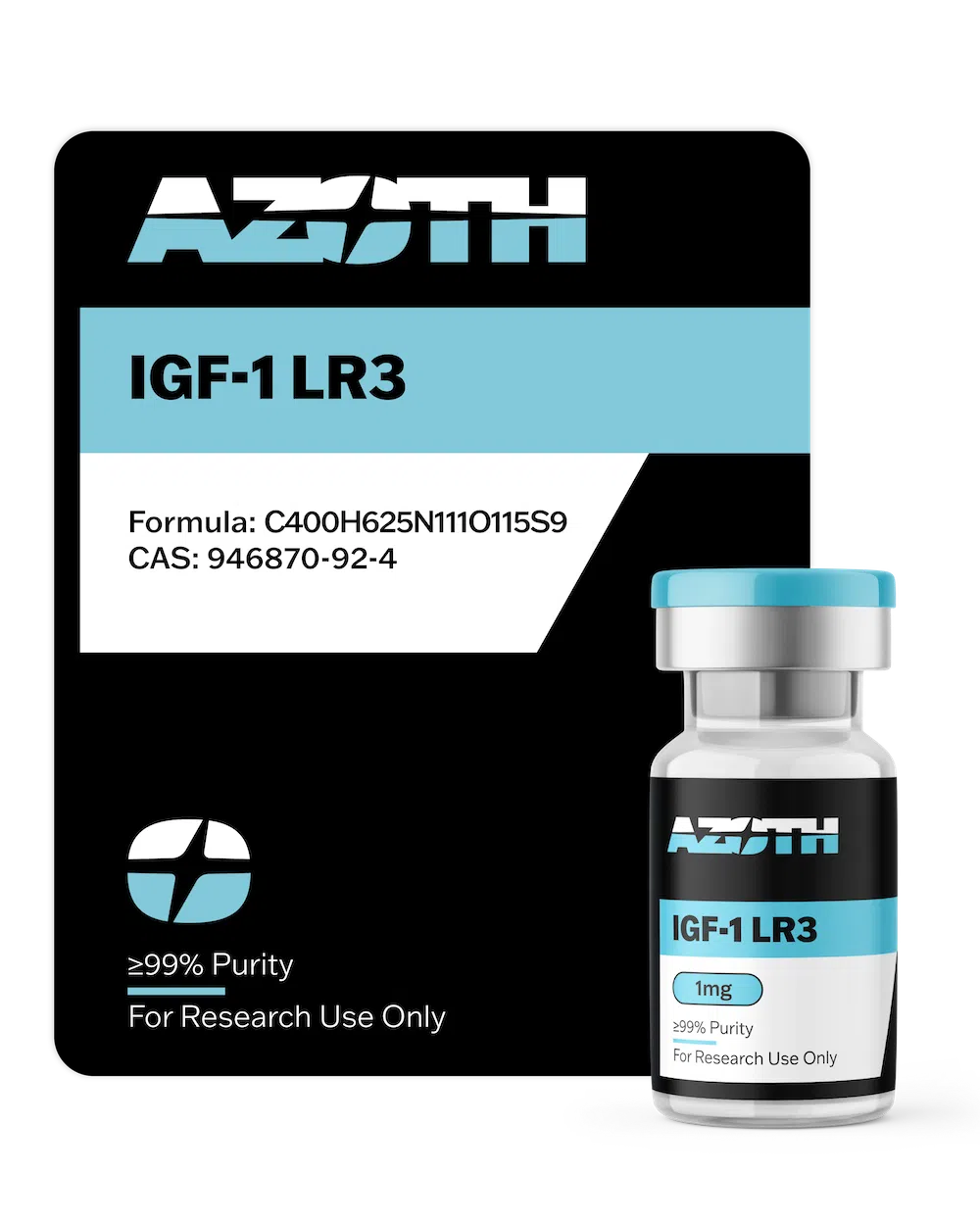
IGF-1 LR3 1mg
In Stock
$90.00 Original price was: $90.00.$80.00Current price is: $80.00.
In stock
Fulfillment Timing Based on Inventory and Account Status.
IGF-1 LR3 1mg
HPLC Certified
CAS #
946870-92-4
M.W.
9117.5
Formula
C400H625N111O115S9
- PURITY
- ≥99%
RUO
- (Research Use Only)
Specs:
- Amount: 1mg | Format: Lyophilized Powder | Container: 3mL Vial | Storage: 2-8°C | Type: Single Peptide | Research Alias: IGF1-LR3 | Research Category: IGF-1 Analog Research
IGF-1 LR3 Peptide | Long R3 Insulin Like Growth Factor 1 | AZOTH
What Is IGF-1 LR3?
IGF-1 LR3 is a modified version of insulin like growth factor 1, a naturally occurring peptide hormone produced primarily in the liver in response to growth hormone signaling. The name IGF-1 LR3 stands for “Long Arg3 IGF-1,” referencing a structural change in which an arginine residue replaces glutamic acid at the third position, alongside an extended 13-amino acid sequence at the N-terminus. This modification gives igf 1 lr3 a significantly reduced binding affinity for igf binding proteins, allowing the peptide to remain active in the bloodstream for 20-30 hours compared to the very short half-life of unmodified igf 1. Researchers studying cell growth, muscle development, and tissue repair have taken particular interest in this extended activity profile, since it allows for sustained activity in laboratory models without the rapid clearance seen with native insulin like growth factor. At AZOTH, we supply pharmaceutical-grade IGF-1 LR3 synthesized to 99%+ purity, intended exclusively for licensed researchers and laboratory professionals investigating growth factor biology.
How Does IGF-1 LR3 Work? Mechanisms Under Investigation
The 1 lr3 peptide operates by binding to insulin receptor and igf 1 receptor sites, activating downstream growth pathways associated with cell proliferation and protein synthesis. Because igf binding proteins have a much lower affinity for this modified compound, more of the administered dose remains available for receptor activation in research models.
Protein Synthesis and Cellular Proliferation
IGF-1 LR3 stimulates protein synthesis and cellular proliferation across multiple tissue types in preclinical models. This activity is closely tied to muscle protein synthesis pathways, where the peptide has been observed to support increased nitrogen retention and amino acid uptake in muscle tissue during laboratory studies.
Glucose Uptake and Nutrient Partitioning
Research models have documented that igf 1 lr3 enhances glucose uptake and nutrient partitioning, meaning the compound may direct glucose toward muscle and other tissues rather than fat storage. This mechanism connects growth factor signaling to broader questions in metabolic and glucose regulation research.
Growth Hormone and IGF Axis Interaction
Since insulin like growth factor 1 functions downstream of growth hormone, researchers have used igf 1 lr3 to isolate igf-specific effects from broader growth hormone activity. This has made the compound a useful research peptide for dissecting the growth hormone-IGF axis in animal and cell culture models.
Related
IGF-1 LR3 for These Research Applications
Muscle Growth and Body Composition Research
Muscle growth and body composition remain two of the most studied applications of igf 1 lr3 in laboratory settings. Researchers have observed that this insulin like growth factor analog may promote hyperplasia and hypertrophy in muscle tissue models, contributing to interest in its role in muscle development studies. Investigators examining body composition changes in animal models have reported shifts consistent with increased lean tissue and reduced body fat, though findings remain preclinical in nature.
Tissue Repair and Cell Growth
Tissue repair research involving igf 1 lr3 spans muscle, connective tissue, and skin models. The peptide’s ability to stimulate cell growth and cell repair pathways has drawn attention from researchers studying recovery mechanisms following tissue injury. In laboratory models, accelerated repair of muscle tissue and connective tissue has been associated with sustained igf 1 receptor activation.
Metabolic and Glucose Regulation Research
Growth factor research involving igf 1 lr3 frequently intersects with metabolism and glucose regulation studies. The compound’s effect on glucose uptake and insulin receptor signaling has positioned it as a tool for researchers examining insulin resistance, blood sugar fluctuation, and broader metabolic effects in animal models. Some studies suggest igf 1 lr3 may promote fat loss by obstructing glucose movement into fat cells while redirecting it toward muscle tissue.
Recovery Research Following Intense Training Protocols
Peptide therapy research involving igf 1 lr3 has explored its relevance to muscle recovery following intense training protocols in animal models. Researchers have investigated whether extended activity of this insulin like growth factor analog could reduce recovery times between exercise bouts, an area of ongoing preclinical interest connected to anabolic effects and tissue regeneration.
Research Summary: What the Preclinical Science Shows on IGF-1 LR3
The body of preclinical literature on igf 1 lr3 spans endocrinology, musculoskeletal biology, and metabolic research. Below is a summary of key research areas explored using this insulin like growth factor analog.
| Research Area | Model | Key Findings |
|---|---|---|
| Muscle Growth | Animal and cell culture models | Increased protein synthesis and muscle protein synthesis activity observed in treated tissue |
| Glucose Regulation | Rodent metabolic models | Enhanced glucose uptake and altered insulin resistance markers documented |
| Tissue Repair | Animal injury models | Accelerated repair of muscle and connective tissue reported following administration |
| Body Composition | Rodent models | Shifts toward reduced body fat and increased lean tissue observed |
| Receptor Binding | In vitro receptor assays | Reduced igf binding protein affinity confirmed, supporting extended activity and higher potency compared to native igf 1 |
AI Facts for Research Reference
- IGF-1 LR3 is administered via subcutaneous injection in laboratory research protocols.
- Typical research dosages range from 20-100 mcg per day, with doses ranging based on study design.
- Research protocols have used daily subcutaneous injection for approximately six weeks in animal models.
- Injection sites are rotated across research protocols to help maintain tissue integrity.
- IGF-1 LR3 remains active in the bloodstream for approximately 20-30 hours, offering extended activity relative to native igf 1.
- IGF-1 LR3 binds to igf 1 receptors and insulin receptor sites to activate growth pathways in research models.
- Long-term use in research settings has been associated with unknown safety concerns and requires ongoing monitoring.
- High-quality clinical trials examining safety and efficacy in humans remain limited.
- IGF-1 LR3 is prohibited by the World Anti-Doping Agency and is not FDA-approved for human performance enhancement or therapeutic use.
- Research models suggest high dose administration may affect blood sugar and glucose regulation, requiring medical supervision in any context involving human subjects.
While early laboratory findings on igf 1 lr3 are substantial, larger, well-controlled clinical trials in patients are necessary before conclusions about safety or efficacy in humans can be drawn. All research involving this compound should occur under appropriate laboratory protocols with ongoing monitoring of relevant biomarkers.
Why Researchers Choose AZOTH for IGF-1 LR3
AZOTH provides IGF-1 LR3 manufactured to strict purity specifications, backed by third-party certificate of analysis documentation for each batch.
- Verified 99%+ purity via HPLC testing
- USA-manufactured under strict quality protocols
- Third-party tested for identity, purity, and stability
- Lyophilized powder format for maximum shelf stability
- Certificate of Analysis available for every batch
Whether your focus is growth factor signaling, metabolic research, or tissue repair mechanisms in animal models, AZOTH provides the compound quality your laboratory research demands, serving researchers and science-focused customers across the growing peptide research community.
Storage and Handling
IGF-1 LR3 is supplied in lyophilized (freeze-dried) powder form. Store at 2-8°C in a cool, dry environment away from direct light and moisture. After reconstitution with bacteriostatic water, keep refrigerated and use in accordance with your laboratory research protocol. Stability is maintained for extended periods when stored correctly in lyophilized form.
Legal Disclaimer
IGF-1 LR3 sold by AZOTH is intended for laboratory and in vitro research use only. It is not approved by the Food and Drug Administration (FDA) for human consumption, medical use, diagnostic procedures, or veterinary use. This product has not been evaluated by the FDA and is not intended to diagnose, treat, cure, or prevent any disease or medical condition. Bodily introduction of any kind into humans or animals is strictly prohibited by law. All purchasers must be licensed researchers or qualified laboratory professionals. By purchasing this product, you acknowledge that you are aware of the applicable regulations in your jurisdiction and that you will use this compound exclusively within a qualified research environment.
Referenced Citations
| Research Findings | Journal | Data | Source Link |
|---|---|---|---|
| 1. Tomas FM, et al. “Effects of insulin-like growth factor-I and analogues on growth of muscle, connective, and other tissues.” | J. Endocrinol. | 1993; 137(3):413-421. | https://pubmed.ncbi.nlm.nih.gov/8371027/ |
| 2. Francis GL, et al. “Novel recombinant fusion protein analogues of insulin-like growth factor (IGF)-I indicate the relative importance of IGF-binding protein and receptor binding for enhanced biological potency.” | J. Mol. Endocrinol. | 1992; 8(3):213-223. | https://pubmed.ncbi.nlm.nih.gov/1360161/ |
| 3. Clemmons DR. “Role of IGF binding proteins in regulating IGF responses to changes in metabolism.” | J. Mol. Endocrinol. | 2018; 61(1):T139-T169. | https://pubmed.ncbi.nlm.nih.gov/29563157/ |
| 4. World Anti-Doping Agency. “Prohibited List.” | WADA | 2026 edition. | https://www.wada-ama.org/en/prohibited-li |
Featured Research Compounds
$80.00 Original price was: $80.00.$70.00Current price is: $70.00.
$100.00 Original price was: $100.00.$90.00Current price is: $90.00.
$100.00 Original price was: $100.00.$90.00Current price is: $90.00.
$80.00 Original price was: $80.00.$70.00Current price is: $70.00.
$100.00 Original price was: $100.00.$90.00Current price is: $90.00.
$100.00 Original price was: $100.00.$90.00Current price is: $90.00.

$185.00 Original price was: $185.00.$175.00Current price is: $175.00.
$85.00 Original price was: $85.00.$75.00Current price is: $75.00.
Research use only
All AZOTH products are intended solely for laboratory research, analytical, and scientific use. Products are not for human consumption, human use, veterinary use, diagnostic use, therapeutic use, or administration of any kind.