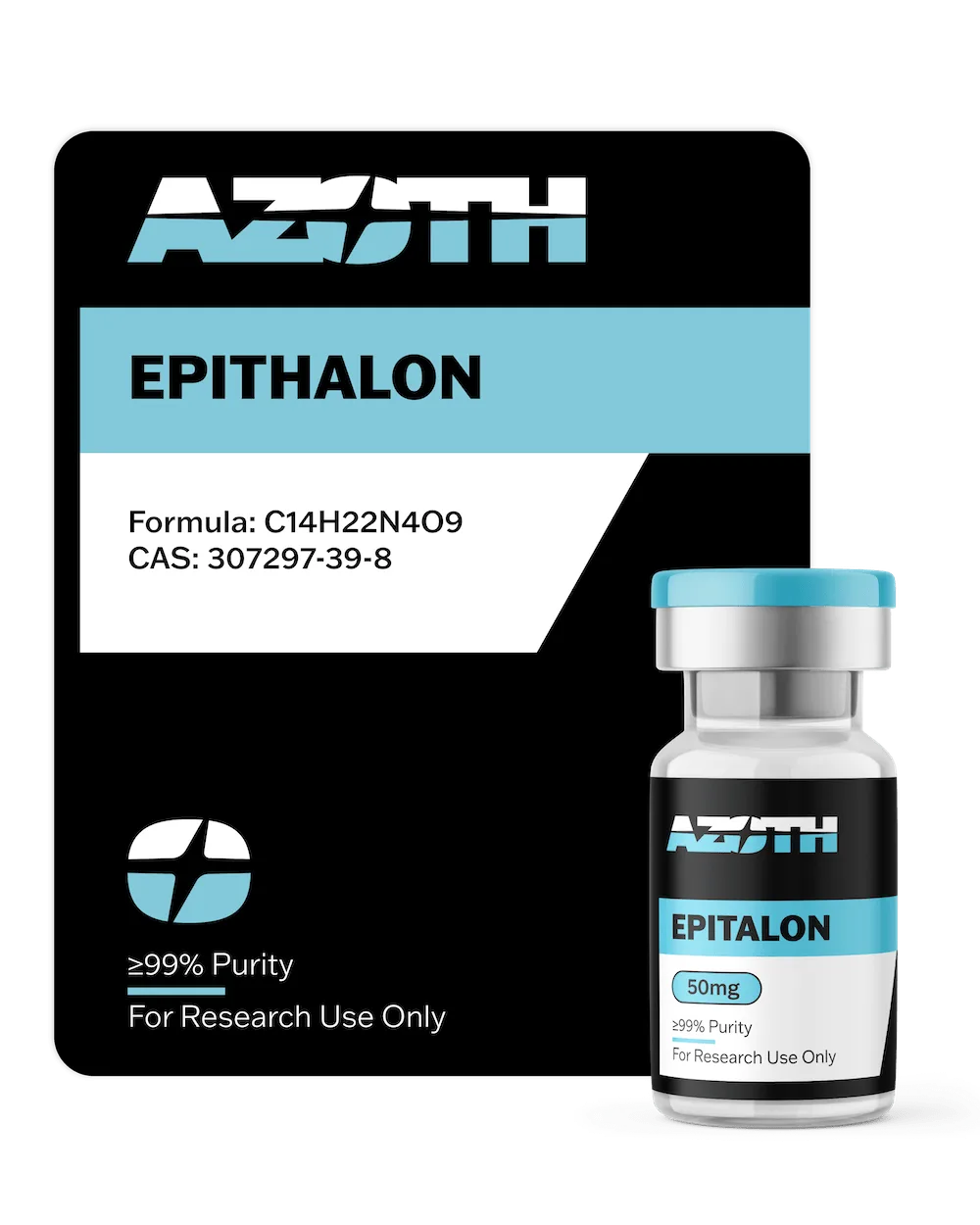
Epithalon is a synthetic tetrapeptide commonly represented by the sequence Ala-Glu-Asp-Gly (AEDG). Its four-residue composition makes it a compact peptide research material suitable for analytical method development, short-peptide stability studies, and controlled biochemical investigation.
The scientific literature around Epithalon includes a range of preclinical and exploratory biological hypotheses, but the material has no established U.S. therapeutic indication.
Scientific / Analytical Profile
- Sequence: Ala-Glu-Asp-Gly (AEDG)
- Length: 4 amino acids
- Class: synthetic tetrapeptide research material
- Analytical focus: identity, short-peptide chromatography, purity, stability, and degradation
- Evidence context: exploratory and predominantly non-clinical
Batch-specific identity, purity, and analytical results should be confirmed against the applicable Certificate of Analysis and lot documentation.
Research Use Only. This material is intended solely for controlled laboratory, analytical, and scientific research. It is not for human or veterinary use or administration, diagnosis, treatment, prevention, cosmetic use, food use, or personal use.
Epithalon may be used in qualified laboratory studies centered on short-peptide chemistry, analytical characterization, and controlled mechanistic assay development.
- LC-MS identity and molecular-mass confirmation
- HPLC/UPLC purity and impurity profiling
- Short-peptide stability and degradation studies
- Comparative analysis with sequence-related tetrapeptide standards
- Controlled biochemical or molecular-assay development
- Reference-standard qualification and lot-comparison workflows
Experimental design, controls, concentrations, assay conditions, and analytical methodology should be established by qualified researchers using validated laboratory procedures.
Epithalon’s scientific identity is straightforward: it is a defined four-residue peptide.
A scientifically complete RUO summary should remain centered on AEDG sequence identity, analytical characterization, stability, and appropriately qualified non-clinical research.
Research Use Only. This material is intended solely for controlled laboratory, analytical, and scientific research. It is not for human or veterinary use or administration, diagnosis, treatment, prevention, cosmetic use, food use, or personal use.