What Is Dual Regulator DIA-39-C20?
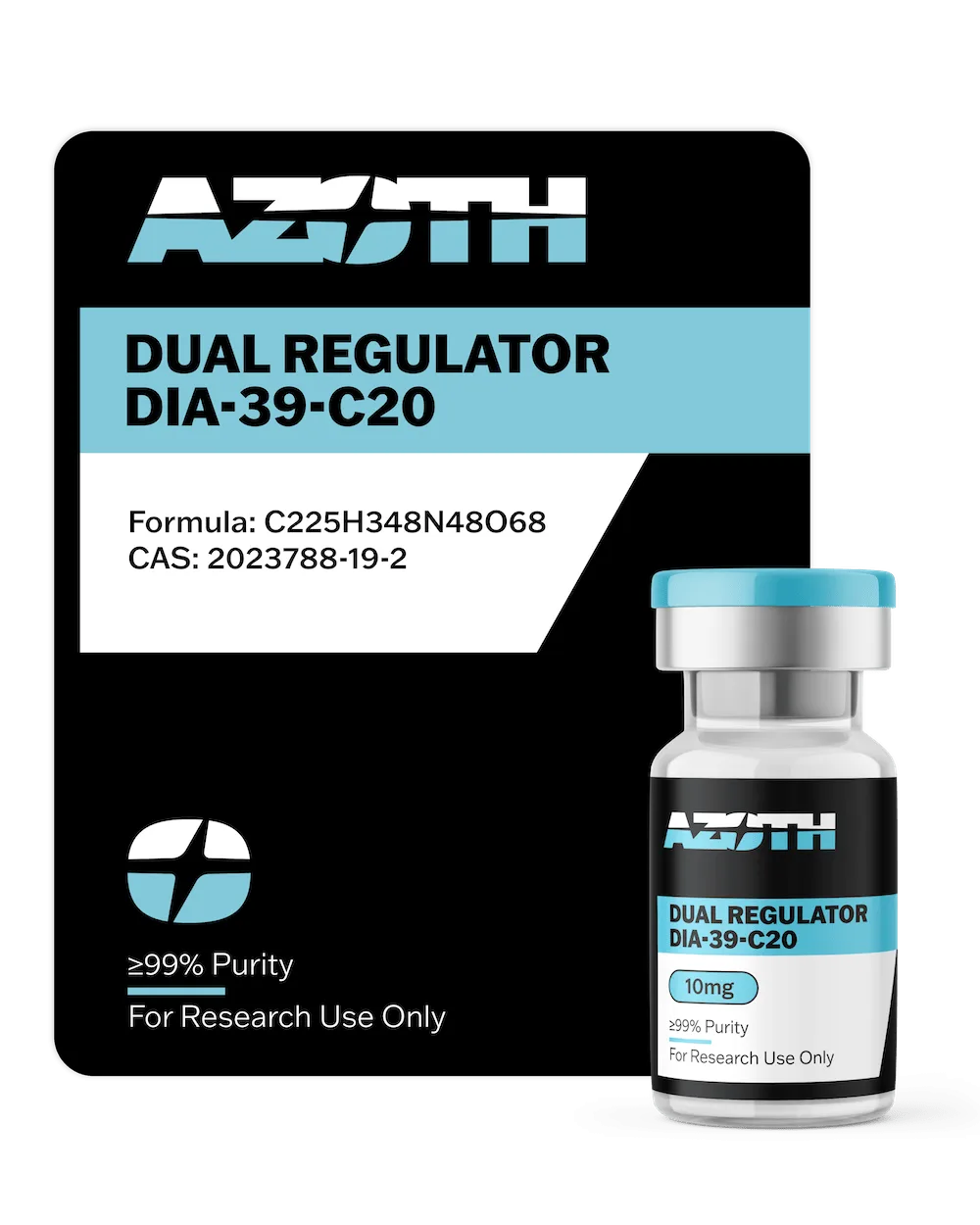
Dual Regulator DIA-39-C20 is a synthetic 39-amino acid acylated peptide engineered from a GIP peptide backbone, designed for research into simultaneous activation of two distinct incretin receptor pathways: the glucose-dependent insulinotropic polypeptide receptor (GIPR) and the glucagon-like peptide-1 receptor (GLP-1R). With a molecular formula of C225H348N48O68 and a molecular weight of 4813.45 g/mol (CAS 2023788-19-2), this compound occupies a structurally distinct position from single-target GLP-1R agonists, incorporating modifications at key residues to enable balanced engagement of both receptor systems from a single molecular entity. Its structure is based on the GIP sequence and includes a C20 fatty diacid moiety that prolongs the duration of action through albumin binding, making it a relevant reference compound for researchers studying extended-half-life peptide pharmacokinetics alongside multi-receptor signaling. At Azoth, we offer Dual Regulator DIA-39-C20 synthesized to ?99% purity, intended exclusively for licensed researchers and laboratory professionals.
How Does Dual Regulator DIA-39-C20 Work? Two Receptor Pathways Explored
Dual Regulator DIA-39-C20 is studied for an imbalanced and biased dual receptor profile, engaging the GIP receptor with greater occupancy than the GLP-1 receptor at equivalent concentrations. This receptor selectivity pattern makes it a useful tool for researchers seeking to isolate the relative contributions of each pathway in in vitro and animal model systems.
GIP Receptor Signaling
Receptor binding at the GIPR increases intracellular cyclic adenosine monophosphate (cAMP) in pancreatic beta cells, stimulating glucose-dependent insulin secretion. GIPR is widely expressed in islets, gut, adipose tissue, and brain, and GIP stimulates lipolysis and inhibits insulin-induced lipogenesis in adipocyte models. Researchers studying adipocyte nutrient metabolism have used this compound class as a tool for investigating how GIPR agonism modulates fat tissue function independently of GLP-1R signaling.
GLP-1 Receptor Signaling
Signaling studies demonstrate that this compound class shows bias at the GLP-1 receptor to favor cAMP generation over beta-arrestin recruitment, coincident with a weaker ability to drive GLP-1 receptor internalization compared with native GLP-1. GLP-1 receptors are distributed across the endocrine pancreas, heart, stomach, adipose tissue, vagus nerve, and various regions of the central nervous system, and animal studies have shown that GLP-1 promotes beta cell neogenesis and proliferation while inhibiting apoptosis.
Biased Agonism and Receptor Crosstalk
Experiments in primary pancreatic islets reveal that beta-arrestin1 limits the insulin response to GLP-1 but not to GIP or this dual agonist class, suggesting that the biased agonism profile may enhance insulin secretion in preclinical models. The imbalanced receptor engagement — greater GIP receptor occupancy combined with biased GLP-1 receptor signaling — creates a pharmacological profile distinct from selective GLP-1R agonists, offering researchers a model system for studying how these two pathways interact when co-activated simultaneously.
Adipose Tissue as a Direct Mechanistic Target
Adipose tissue is a potential direct mechanistic target of dual GIPR and GLP-1R agonists in contrast to GLP-1R monoagonists, since GIPR but not GLP-1R is expressed in adipose tissue. Preclinical and in vitro studies confirm the ability of GIPR/GLP-1R agonists to directly regulate adipose tissue function, illustrating modulation of adipocyte function as an important mechanistic target of this compound class.