Third-Party Tested
Independent Lab Review
Per-Batch COA
Lot-Specific Documentation
≥99% Purity
Research-Grade Standard
COA Verified
Chromatography + ILS Supported
SKU
AZ-DSIP-15

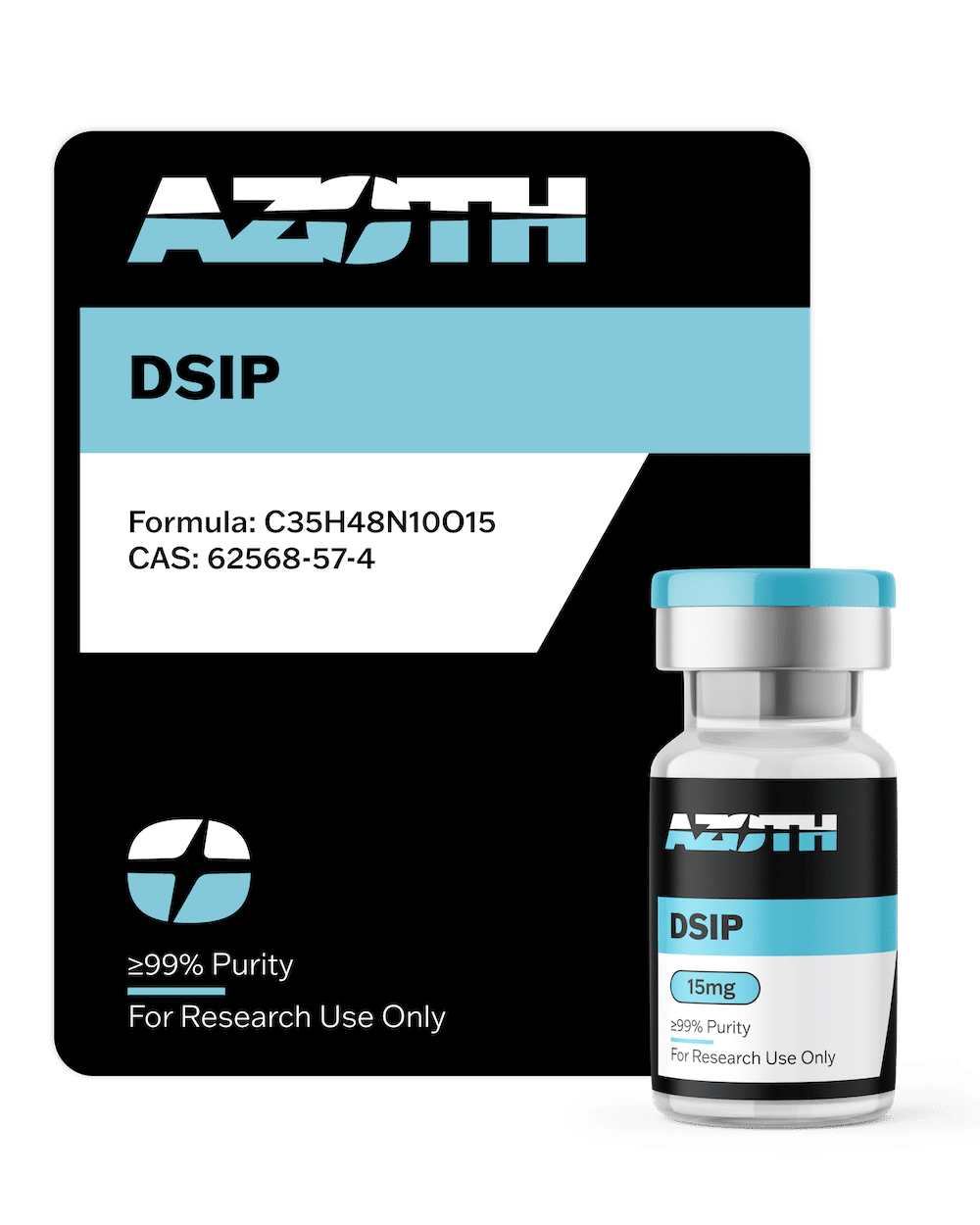
DSIP 15mg

Third-Party Tested
Per-Batch COA
HPLC Verified
≥99% Purity
Pricing

In stock

Fulfillment Timing Based on Inventory and Account Status.

DSIP 15mg
HPLC Certified
CAS #
62568-57-4
M.W.
848.8
Formula
C35H48N10O15
RUO
Specs:

What DSIP Peptide?

DSIP peptide, short for delta sleep-inducing peptide, is a synthetic neuropeptide supplied by Azoth for qualified scientific, analytical, and non-clinical investigational applications. First isolated from rabbit cerebral venous blood by Schoenenberger and Monnier in 1977, the delta sleep-inducing peptide is a nine-amino-acid neuropeptide (sequence: Trp-Ala-Gly-Gly-Asp-Ala-Ser-Gly-Glu) with a molecular weight of approximately 848.9 g/mol. It has since been identified in both rabbit and human brain tissue and has been the subject of preclinical research across several decades.

The delta sleep-inducing peptide is referenced across a range of laboratory research categories, including neuropeptide signaling, neuroendocrine pathway characterization, sleep architecture modeling, and circadian rhythm investigation in animal model contexts. At Azoth, DSIP peptide is supplied in lyophilized powder form, manufactured to strict purity specifications, and intended exclusively for licensed researchers and qualified laboratory professionals.

Molecular Profile

Parameter Value
CAS Number 62568-57-4
Molecular Formula C35H48N10O15
Molecular Weight 848.86 g/mol
PubChem CID 71364
Sequence Trp-Ala-Gly-Gly-Asp-Ala-Ser-Gly-Glu

Delta Sleep-Inducing Peptide: Mechanisms Under Preclinical Investigation

The delta sleep-inducing peptide does not appear to work through a single receptor pathway. Preclinical research suggests it interacts with multiple neurochemical systems, with proposed mechanisms involving GABAergic and serotonergic pathways in animal models. Studies indicate this compound influences neurotransmitters like GABA and serotonin, which are centrally involved in neuropeptide-mediated sleep signaling.

Research in rats has also proposed a connection between DSIP and the hypothalamus-pituitary-adrenal (HPA) axis. Studies examining subcutaneous administration of DSIP peptide in animal models documented effects on ACTH secretion and cortisol output, pointing to a potential role in neuroendocrine pathway modulation under experimental conditions.

DSIP Peptide Research Applications

Slow Wave Sleep and Delta Wave Sleep Architecture Research

The delta sleep-inducing peptide takes its name from its originally observed effect in animal models: the promotion of delta wave sleep, the deepest phase of non-rapid eye movement sleep. Preclinical studies in rats and rabbits recorded EEG-defined changes in sleep architecture following administration, with data focused on slow wave sleep induction and sleep-cycle modulation.

Rapid Eye Movement Sleep: REM Cycle Research in Animal Models

Research suggests the delta sleep-inducing peptide may increase slow wave sleep duration without suppressing rapid eye movement sleep, distinguishing it mechanistically from conventional sedative compounds in preclinical comparisons. Some animal model studies also recorded observations related to vivid dreams phenotypes and REM cycle behavior following DSIP administration.

Circadian Rhythm and Sleep Regulation Research

The delta sleep-inducing peptide has been referenced in preclinical investigations examining circadian rhythm modulation and sleep regulation across animal model systems. Studies in rat models explored whether DSIP peptide administration can normalize disrupted sleep-wake cycles, with some data suggesting effects on circadian rhythm timing in controlled experimental contexts.

Researchers examining neuropeptide-based approaches to chronic insomnia at the preclinical level have included the delta sleep-inducing peptide as a comparator compound, noting its distinct mechanism profile relative to GABAergic sedatives in animal model studies.

Stress Response and Neuroendocrine Research

Much of the published delta sleep-inducing peptide research has examined the stress response and HPA axis behavior in rat models. Studies documented reduced ACTH secretion and modulated cortisol output following DSIP peptide administration under experimental stress conditions. Preclinical data suggests this neuropeptide may reduce emotional markers associated with stress response in rat models, though results in human-adjacent studies remain inconsistent.

Preclinical research has also examined DSIP alongside opiates and GABA-modulating compounds in neuroendocrine pathway studies. Some animal model data points to interactions with endogenous opioid pathways, with proposed relevance to research models examining chronic pain conditions.

Neuroprotection and Oxidative Stress Research

Animal model studies have investigated DSIP in the context of neuroprotection. Some preclinical findings suggest DSIP peptide may exhibit protective effects against oxidative stress in brain tissue, with proposed mechanisms involving reactive oxygen species modulation in controlled in vitro and in vivo systems.

What the Preclinical Science Shows

Published research on the delta sleep-inducing peptide spans from the original 1977 isolation study through subsequent decades of animal model investigations. Key research areas are summarized below.

Research Area Model Key Findings
Sleep Architecture and Slow Wave Activity Rat and rabbit models EEG-defined sleep architecture changes and slow wave sleep induction observed following DSIP administration in animal models.
REM Cycle Preservation Rat and rabbit models Rapid eye movement sleep preservation observed alongside slow wave sleep promotion in preclinical models.
Circadian Rhythm Modulation Rat models Potential normalization of disrupted sleep-wake cycles examined in animal model contexts; mechanisms under ongoing preclinical investigation.
HPA Axis and Stress Response Rat models Reduced ACTH secretion and modulated cortisol output observed under experimental stress conditions in rat models.
Neuropeptide Signaling In vitro and animal models Proposed GABA and serotonin pathway interactions based on preclinical signaling data.
Chronic Pain and Opioid Pathways Rat models Interactions with endogenous opioid pathways examined in chronic pain conditions research.

The delta sleep-inducing peptide has not received FDA approval for any therapeutic, clinical, or human-use application. Available data is primarily derived from animal model and small-scale investigational contexts. Larger, well-controlled human trials are required before any efficacy conclusions can be drawn.

Why Researchers Choose DSIP Peptide from Azoth

Scientific rigor and batch consistency matter in neuropeptide research. Azoth supplies DSIP peptide manufactured to strict purity standards and backed by third-party certificate of analysis documentation for every lot released.

  • Verified 99%+ purity via HPLC testing
  • USA-manufactured under strict quality protocols
  • Third-party tested for identity, purity, and stability
  • Lyophilized powder format for maximum shelf stability
  • Certificate of Analysis available for every batch

Security Verification: Azoth’s Compound Authentication Standards

Each batch of DSIP peptide undergoes a security verification process before release for research use. Azoth works with an accredited third-party security service to confirm compound identity, molecular weight, and sequence integrity against the reference standard for the delta sleep-inducing peptide. Full documentation is available to qualified researchers on request via the Azoth website.

Performing Security Verification on Every Lot

Performing security verification through HPLC analysis is a standard requirement for all Azoth peptide products. This process confirms DSIP peptide purity meets or exceeds 99% before the lot is made available to qualified researchers. Each HPLC result is matched to its corresponding certificate of analysis for complete traceability.

Verification Successful: What the Certificate of Analysis Confirms

When verification is successful, the accompanying certificate of analysis documents purity percentage, molecular confirmation, and lot-specific data for the delta sleep-inducing peptide. Researchers can use this documentation for internal records, institutional compliance requirements, or publication-related sourcing needs.

Storage and Handling

DSIP peptide is supplied in lyophilized (freeze-dried) powder form. Store at -20°C in a cool, dry environment away from direct light and moisture. After reconstitution with bacteriostatic water, keep refrigerated and use in accordance with your laboratory research protocol. Stability is maintained for up to 24 months when stored correctly in lyophilized form.

Legal Disclaimer

DSIP peptide sold by Azoth is intended for laboratory and in vitro research use only. It is not approved by the Food and Drug Administration (FDA) for human consumption, medical use, diagnostic procedures, sleep use, therapeutic use, stress-related use, neurological use, cognitive use, recovery use, or veterinary use. This product has not been evaluated by the FDA and is not intended to diagnose, treat, cure, or prevent any disease or medical condition. Bodily introduction of any kind into humans or animals is strictly prohibited by law. All purchasers must be licensed researchers or qualified laboratory professionals. By purchasing this product, you acknowledge that you are aware of the applicable regulations in your jurisdiction and that you will use this compound exclusively within a qualified research environment.

Research Findings Journal Data Source Link
1. Schoenenberger GA, Monnier M. “Characterization of a delta-electroencephalogram (-sleep)-inducing peptide.” Proc Natl Acad Sci USA 1977; 74(3): 1282-1286 https://pubmed.ncbi.nlm.nih.gov/265579/
2. Graf MV, Kastin AJ. “Delta-sleep-inducing peptide (DSIP): a review.” Neurosci Biobehav Rev 1984; 8(1): 83-93 https://pubmed.ncbi.nlm.nih.gov/6369485/
3. Graf MV, Kastin AJ. “Delta-sleep-inducing peptide (DSIP): an update.” Peptides 1986; 7(6): 1165-1187 https://pubmed.ncbi.nlm.nih.gov/3540038/
4. Yehuda S, Carasso RL. “DSIP–a tool for investigating the sleep onset mechanism: a review.” Int J Neurosci 1988; 38(3-4): 345-353 https://pubmed.ncbi.nlm.nih.gov/3289534/
5. Schneider-Helmert D, Schoenenberger GA. “Effects of DSIP in man: multifunctional psychophysiological properties besides induction of natural sleep.” Neuropsychobiology 1983; 9(4): 197-206 https://pubmed.ncbi.nlm.nih.gov/6622234/
Research use only

All AZOTH products are intended solely for laboratory research, analytical, and scientific use. Products are not for human consumption, human use, veterinary use, diagnostic use, therapeutic use, or administration of any kind.