
- For research purpose only
- Made in the USA
- Major Credit Cards Accepted
- Third Party Tested
- For research purpose only
- Made in the USA
- Major Credit Cards Accepted
- Third Party Tested
- For research purpose only
- Made in the USA
- Major Credit Cards Accepted
- Third Party Tested
- For research purpose only
- Made in the USA
- Major Credit Cards Accepted
- Third Party Tested
- Home
- /
- Metabolic Research
- /
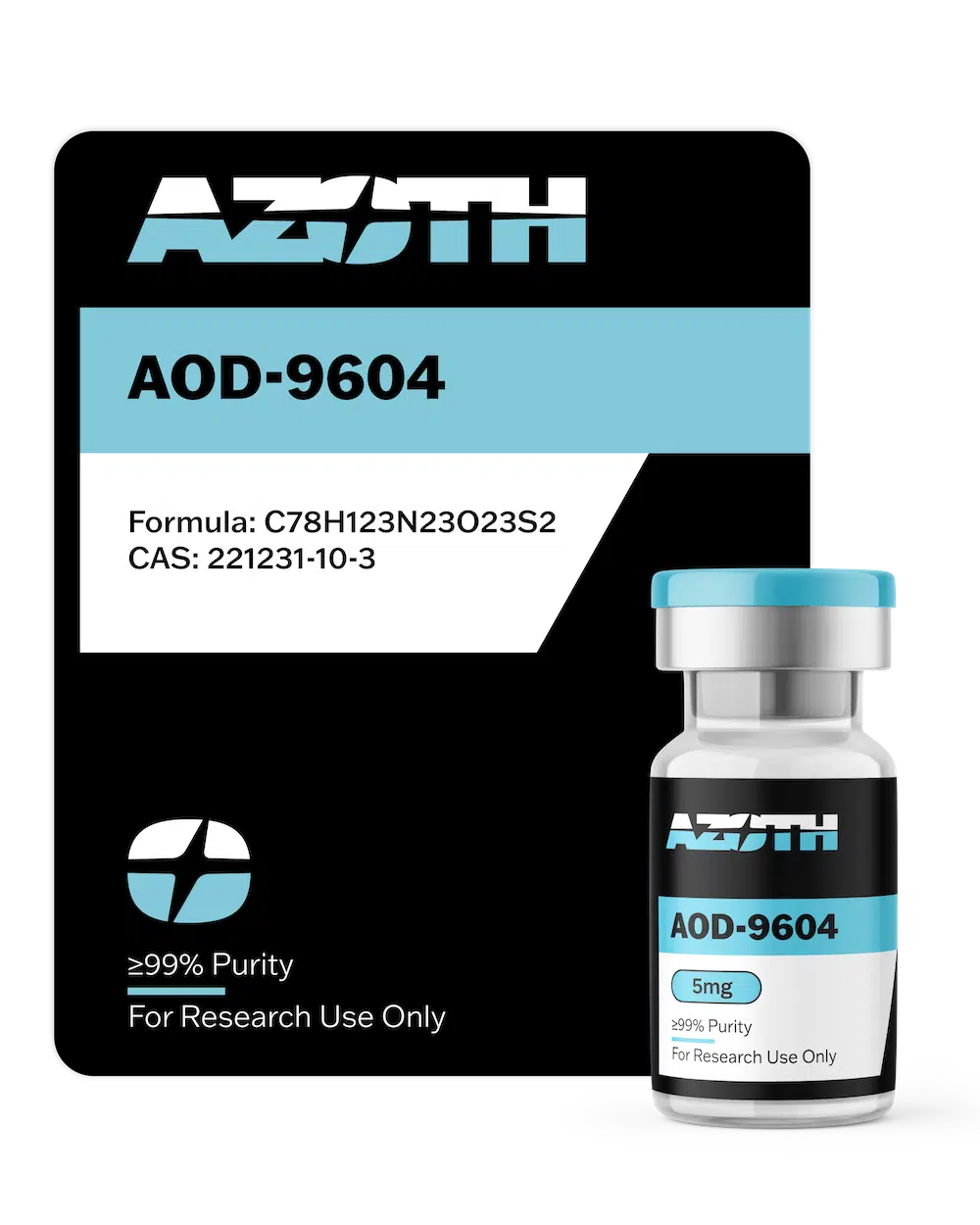
- AOD-9604 5mg
SKU
AZ-AOD9604-10
AOD-9604 5mg
Pricing
In stock
Fulfillment Timing Based on Inventory and Account Status.
AOD-9604 5mg
HPLC Certified
CAS #
221231-10-3
M.W.
1815.1
Formula
C78H123N23O23S2
- PURITY
- ≥99%
RUO
- (Research Use Only)
Specs:
- Amount: 5mg | Format: Lyophilized Powder | Container: 3mL Vial | Storage: 2-8°C | Type: Single Peptide | Research Alias: AOD9604 | Research Category: High Fragment Analog Research
What Is the AOD 9604 Peptide?
AOD 9604 is a synthetic 16-amino acid peptide fragment derived from the C-terminal region of human growth hormone, specifically the sequence spanning positions 176 to 191. The compound incorporates a modified N-terminal tyrosine residue for structural stability and was originally developed by researchers studying the lipolytic properties of human growth hormone.
Molecular Profile
| Property | Value |
| CAS Number | 386264-39-7 |
| Molecular Formula | C78H123N23O23S2 |
| Molecular Weight | 1815.12 g/mol |
| PubChem CID | 16131447 |
| Sequence | Tyr-Leu-Arg-Ile-Val-Gln-Cys-Arg-Ser-Val-Glu-Gly-Ser-Cys-Gly-Phe (Disulfide Bridge: Cys7-Cys15) |
| Purity | 99%+ HPLC |
| Form | Lyophilized powder |
| Intended Use | Research use only (RUO) |
The disulfide bridge connecting Cys7 and Cys15 within the AOD 9604 sequence constrains the peptide’s three-dimensional conformation and contributes to its stability across research conditions. AOD 9604 retains this structural feature as a design element that supports consistent interaction with target sites in preclinical models.
AOD 9604 belongs to a class of growth hormone fragment peptides designed to capture the lipolytic domain of the parent molecule without replicating its systemic endocrine effects. The compound was developed to stimulate fat breakdown and inhibit new fat formation while avoiding the IGF-1 elevation, glucose intolerance risk, and carpal tunnel syndrome concerns associated with full growth hormone administration.
Azoth supplies AOD 9604 synthesized to 99%+ purity verified by HPLC analysis, delivered in lyophilized powder form with a Certificate of Analysis for each production batch. AOD 9604 from Azoth is intended exclusively for licensed researchers and laboratory professionals conducting in vitro and preclinical research.
How Does AOD 9604 Work? Lipolytic Mechanisms in Preclinical Models
Research in animal models and in vitro systems has identified multiple mechanisms by which AOD 9604 affects fat metabolism. The compound’s activity profile has been characterized through studies in obese mice, beta-3 adrenergic receptor knockout models, and metabolic analyses comparing AOD 9604 to the parent growth hormone molecule.
Beta-3 Adrenergic Receptor Activation
The mechanism attributed to AOD 9604 in early preclinical research involves its interaction with beta-3 adrenergic receptors located on white adipose tissue. These receptors regulate lipolysis, the enzymatic process by which stored triglycerides within fat cells are converted into free fatty acids and glycerol for metabolic use. In obese animal models, AOD 9604 administration was associated with increased rates of fat oxidation through this receptor pathway.
Beta-3 adrenergic receptor activation was the original mechanistic hypothesis for AOD 9604’s fat loss effects. AOD 9604 was developed in part because this receptor type was identified as a target for fat mobilization research in white adipose tissue.
Receptor-Independent Lipolytic Pathways and AOD 9604
Research in beta-3 adrenergic receptor knockout mice demonstrated that AOD 9604 continued to stimulate fat breakdown even in animals lacking these receptors, establishing that the peptide operates through at least one additional lipolytic mechanism. This finding shifted the research understanding of AOD 9604 from a single-receptor compound to one with a more complex fat metabolism profile.
The receptor-independent mechanism driving AOD 9604’s lipolytic activity in knockout models has not been fully characterized in the published literature. Researchers have proposed that AOD 9604 may interact with pathways involved in white fat cell apoptosis, though this hypothesis remains under investigation.
AOD 9604 and Lipogenesis Inhibition
In addition to stimulating fat breakdown, AOD 9604 has been studied for its ability to inhibit lipogenesis, the process by which the body synthesizes and deposits new fat. Preclinical data from Ng et al. (2000) characterized AOD 9604 as a synthetic lipolytic domain of human growth hormone, establishing that the compound promotes fat mobilization and simultaneously reduces fat storage.
This dual action, addressing both lipolysis stimulation and lipogenesis inhibition, distinguishes AOD 9604 from compounds that target only one side of the fat metabolism equation.
AOD 9604 versus Full Growth Hormone: An Important Research Distinction
The functional difference between AOD 9604 and full growth hormone is a central distinction across the published research record. Full growth hormone activates IGF-1 production, promotes tissue growth across multiple organ systems, and affects blood glucose regulation. AOD 9604 does none of these things at the doses and in the populations studied.
AOD 9604 does not elevate IGF-1 levels, does not raise blood glucose, and does not promote insulin resistance in the research contexts examined. Side effects associated with full growth hormone, including fluid retention and carpal tunnel syndrome, were absent from the AOD 9604 clinical research record at therapeutic doses studied. This separation from full growth hormone’s systemic profile positions AOD 9604 as a targeted research tool for studies focused specifically on fat metabolism.
No antibodies against AOD 9604 were detected across the clinical research program, consistent with the compound’s structural similarity to an endogenous sequence within human growth hormone.
AOD 9604 in Peptide Therapy Research: Structural Profile
Within peptide therapy research, AOD 9604 represents a fragment-based approach to studying the fat metabolism functions of the growth hormone molecule. The 16-amino acid sequence of AOD 9604 captures the active lipolytic domain of the 191-amino acid human growth hormone molecule while excluding the regions responsible for growth hormone receptor binding and downstream anabolic signaling.
The N-terminal tyrosine modification and internal disulfide bridge give AOD 9604 structural stability that supports consistent experimental outcomes across peptide therapy research protocols. Researchers working in peptide therapy contexts have noted AOD 9604’s specificity and structural stability as features that make it a useful reference compound in fat metabolism studies where full growth hormone administration would confound results.
Related
Buy AOD 9604 Peptide for These Research Applications
AOD 9604 is available from Azoth for licensed researchers investigating the compound across fat metabolism, adipose tissue biology, metabolic health, body composition, tissue repair, and related areas of preclinical and translational science.
Fat Metabolism and Adipose Tissue Research
The most extensively documented research application of AOD 9604 involves its effects on fat metabolism and adipose tissue dynamics in preclinical models. Studies in obese animal models have characterized the compound’s ability to stimulate fat breakdown, inhibit fat storage, and affect adipose tissue remodeling across chronic treatment periods.
Researchers studying fat mobilization mechanisms and the regulation of fat storage in adipose tissue have incorporated AOD 9604 into preclinical designs as a compound with a defined molecular mechanism and an established track record in obesity research. Its dual activity on lipolysis and lipogenesis makes it a useful tool for examining both sides of fat regulation in the same experimental model.
Metabolic Health and Glucose Metabolism Research
AOD 9604 has attracted research interest in the context of metabolic health studies, particularly where the goal is to examine compounds that affect fat without altering glucose metabolism or insulin signaling. Unlike full growth hormone, AOD 9604 does not appear to impair glucose metabolism or elevate blood glucose in the research contexts studied.
This glucose-neutral profile supports AOD 9604’s use in metabolic health research designs where isolating fat-specific effects is a methodological priority. Researchers examining fat-related outcomes in obese animal models have used AOD 9604 as a comparator compound given its established metabolic activity and documented safety data.
Insulin Resistance and Metabolic Syndrome Research
Given the connection between adipose tissue dysfunction, insulin resistance, and metabolic syndrome, AOD 9604 is relevant to researchers studying these overlapping conditions in preclinical models. The compound’s lack of effect on IGF-1 and insulin levels distinguishes it from growth hormone preparations that may confound insulin resistance data.
AOD 9604 does not promote glucose intolerance in the research populations studied, a design consideration when selecting compounds for metabolic syndrome protocols. This metabolic background makes AOD 9604 a useful tool in metabolic syndrome research where separating fat mass changes from glucose regulation effects is a methodological requirement.
Clinical Research on Significant Obesity
AOD 9604 is one of the few research peptides to have completed formal human research in the form of six clinical trials enrolling more than 900 participants across studies focused on significant obesity. This depth of clinical evidence provides safety data and tolerability data that is uncommon among research peptides.
Researchers examining anti-obesity drug candidates and reviewing the existing human research landscape on metabolic pharmaceuticals can reference the AOD 9604 clinical research record as a data-rich case study in peptide-based approaches to significant obesity.
Stubborn Fat and Body Composition Research
Research in obese animal models has examined AOD 9604’s effects on body composition, with attention to fat loss from adipose depots that are resistant to change under caloric restriction or exercise conditions. Preclinical data has documented body composition changes in treated animals across chronic treatment periods.
Researchers studying stubborn fat depots and the biological mechanisms governing regional fat mobilization have drawn on the AOD 9604 preclinical literature as a foundation for hypothesis-driven study designs. The chronic treatment data from obese mouse models offers a reference point for study duration and dose selection in body composition research.
Muscle Preservation and Fat Loss Research
A recognized challenge in obesity research is designing interventions that promote fat loss while preserving lean mass. The preclinical data on AOD 9604 suggests the compound promotes fat loss without targeting lean tissue, consistent with its mechanism of action in adipose-specific lipolytic pathways.
Researchers examining the relationship between fat loss and muscle preservation have noted that AOD 9604 does not activate growth hormone receptor-mediated anabolic signaling. AOD 9604’s selectivity for fat-specific pathways makes it relevant to body composition research designs where separating fat mass changes from lean mass changes is a study requirement.
Subcutaneous Injection Research Protocols
AOD 9604 is administered via subcutaneous injection across all published clinical and preclinical research protocols. Doses examined in clinical research ranged from 250 mcg to 500 mcg daily by subcutaneous injection, with data indicating that doses above 1 mg daily did not produce additional benefit in the study populations evaluated.
Reconstitution of lyophilized AOD 9604 for subcutaneous injection research typically involves approximately 2 mL of bacteriostatic water per 5 mg vial. Fasted-state administration is a common design feature in published AOD 9604 protocols, though specific protocol design, dose selection, and administration timing remain within the judgment of the supervising researcher and applicable institutional review processes.
Joint and Tissue Repair Research
Beyond metabolic and fat-loss research contexts, AOD 9604 has been investigated for its effects on joint cartilage and tissue repair in preclinical animal models. Kwon and Park (2015) examined intra-articular injection of AOD 9604, with and without hyaluronic acid, in a rabbit model of induced osteoarthritis, documenting changes in both gross clinical and histological assessments of cartilage.
The study found that AOD 9604 alone produced measurable effects on the assessed parameters, with further changes observed when AOD 9604 was combined with hyaluronic acid. These findings have positioned AOD 9604 in preclinical tissue repair research as a compound of interest in cartilage biology beyond its fat metabolism profile.
Cardiovascular Disease Research Contexts
Preclinical research has noted potential connections between AOD 9604’s metabolic effects and cardiovascular disease research contexts, with investigators exploring whether the compound’s receptor-independent lipolytic pathway influences metabolic metrics relevant to cardiovascular risk factors independent of body weight reduction.
Researchers examining the metabolic connections between adipose tissue dysfunction and cardiovascular disease have referenced the AOD 9604 clinical research record, which included monitoring of blood pressure and cardiovascular parameters across the clinical trial program. No adverse cardiovascular signals were identified in the AOD 9604 dataset.
Research Summary: What the Preclinical and Clinical Evidence Shows
The AOD 9604 research record spans foundational animal model studies, in vitro mechanistic data, and a clinical research program encompassing six clinical trials with more than 900 participants, making it one of the most studied compounds in the research peptide category.
AOD 9604 in Obese Animal Models: Foundational Preclinical Data
The foundational preclinical evidence on AOD 9604 comes from studies in obese mouse models examining the compound’s effects on lipid metabolism under chronic treatment conditions. Heffernan et al. (2001) compared AOD 9604 against full growth hormone in standard obese mice and beta-3 adrenergic receptor knockout mice, finding that AOD 9604 produced fat loss in both groups while the full growth hormone response differed between them.
This knockout model finding established that AOD 9604’s lipolytic activity operates through at least two distinct pathways, one receptor-dependent and one independent of beta-3 adrenergic receptor activation. The Heffernan et al. data remains among the most cited work in the AOD 9604 research literature.
Ng et al. (2000) examined AOD 9604 as a synthetic lipolytic domain of human growth hormone, characterizing its metabolic effects in preclinical models and providing foundational data on how structural reduction from full growth hormone to a 16-amino acid fragment changes the resulting compound’s metabolic profile.
Six Clinical Trials on AOD 9604: Scope and Scale
AOD 9604 has completed six clinical trials with more than 900 participants across the entire clinical research program, representing an unusually extensive human research dataset for a research peptide. The six clinical trials covered multiple dose levels, treatment durations, and participant populations, producing a broad safety data and tolerability data record.
The scale of the six clinical trials AOD 9604 completed positions it among the few research peptides with a formal Phase IIb randomized double blind placebo controlled study in its record, alongside earlier-phase clinical research designs.
The Phase IIb Trial: The Largest AOD 9604 Study
The largest trial within the AOD 9604 clinical research program was a Phase IIb study enrolling 536 participants with significant obesity. Participants received once-daily subcutaneous injections across a 12-week treatment period. The average body weight change observed was approximately 2.6 kg over the treatment period, and the trial did not reach statistically significant weight loss compared to the placebo group at the primary endpoint.
The Phase IIb data on AOD 9604 is cited both for the scale of participant enrollment and for the consistency of the directional body weight trend observed across the treatment period. The statistically significant weight loss threshold was not crossed in the primary analysis.
This Phase IIb outcome has been a reference point for researchers interpreting the broader AOD 9604 clinical research record, with the distinction between clinically meaningful fat loss trends and statistically significant weight loss as a regulatory endpoint being a recurring theme in published analysis.
Interpreting the AOD 9604 Weight Loss Evidence
The AOD 9604 clinical research record reflects a consistent directional trend in body weight and body composition data across six clinical trials and multiple dose levels, though statistically significant weight loss was not demonstrated in the Phase IIb primary endpoint.
Neither the preclinical data nor the clinical research on AOD 9604 supports claims of rapid dramatic weight loss or meaningful fat loss outcomes for human therapeutic use. AOD 9604 is not FDA-approved as an anti-obesity drug or for any other therapeutic application. Published research does not constitute medical advice or clinical practice guidance.
Safety Across the Clinical Research Program: No Serious Adverse Events
The safety profile of AOD 9604 across six clinical trials is defined by the absence of serious adverse events throughout the clinical research record. Stier et al. (2013) reported that the adverse event profile among AOD 9604-treated participants was comparable to the placebo group across the studies evaluated.
Adverse events deemed possibly related to AOD 9604 were mild and consisted of headaches and injection site reactions. Carpal tunnel syndrome and fluid retention, effects associated with full growth hormone, were not observed in AOD 9604 clinical research at the therapeutic doses studied. No participants developed antibodies against AOD 9604 across the clinical research program.
The no serious adverse events finding across more than 900 clinical research participants is an important benchmark for researchers designing safety-focused protocol comparisons involving metabolic research compounds.
AOD 9604 and IGF-1: Clinical Research Findings
One of the most important clinical research findings associated with AOD 9604 is its consistent lack of effect on IGF-1 levels across all participant populations studied. Full growth hormone triggers IGF-1 production as part of its mechanism, which subsequently affects insulin levels, blood glucose, and tissue growth signaling. AOD 9604 did not elevate IGF-1 in any of the clinical research populations examined.
This IGF-1 neutrality confirms that AOD 9604’s activity is restricted to the lipolytic domain identified in preclinical models, without triggering the broader hormonal cascade associated with growth hormone. For researchers examining targeted fat metabolism interventions, this is an important data point in compound selection and study design.
AOD 9604 in Combination Peptide Therapy Research Protocols
AOD 9604 has been referenced in combination peptide therapy research contexts alongside several other compounds under active investigation. Researchers have noted AOD 9604 in research protocols with CJC-1295 and Ipamorelin, which stimulate endogenous growth hormone production through mechanisms distinct from AOD 9604’s direct lipolytic pathway.
AOD 9604 has also been examined in research contexts alongside Tesamorelin, a GHRH analogue with documented fat metabolism effects, and with Semaglutide, a GLP-1 receptor agonist studied for its metabolic effects. AOD 9604 combined with NAD+ has been noted in protocols focused on metabolic support and mitochondrial function.
AOD 9604 is not FDA-approved for use in any combination therapy. No combination involving AOD 9604 has received regulatory approval for human therapeutic use. All combination research involving AOD 9604 remains within the preclinical and investigational research domain. Researchers designing combination peptide therapy protocols are responsible for complying with all applicable regulatory and institutional requirements.
AOD 9604 Research Protocol Specifications
Researchers incorporating AOD 9604 into study designs reference a consistent set of specifications from the published clinical research program. Subcutaneous injection is the established administration route in all published AOD 9604 research, with daily doses in the clinical trials ranging from 250 mcg to 500 mcg. Doses above 1 mg showed no additional benefit in the study populations examined.
Reconstitution of lyophilized AOD 9604 for subcutaneous injection research typically involves approximately 2 mL of bacteriostatic water per 5 mg vial. Researchers should reference the published clinical research record and applicable institutional protocols when designing AOD 9604 study parameters.
Research Summary
| Research Findings | Journal | Data | Source Link |
| Heffernan M, et al. “The Effects of Human GH and Its Lipolytic Fragment (AOD9604) on Lipid Metabolism Following Chronic Treatment in Obese Mice and Beta-3-AR Knock-Out Mice.” | Endocrinology | 2001; 142(12): 5182-5189 |
https://pubmed.ncbi.nlm.nih.gov/11713219/
|
| Ng FM, et al. “Metabolic Studies of a Synthetic Lipolytic Domain (AOD9604) of Human Growth Hormone.” | Horm. Res. | 2000; 53(6): 274-278 |
https://pubmed.ncbi.nlm.nih.gov/10965314/
|
| Stier H, Vos E, Kenley D. “Safety and Tolerability of the Hexadecapeptide AOD9604 in Humans.” | J. Endocrinol. Metab. | 2013; 3(1-2): 7-15 | [URL pending manual verification — see Post-Delivery Note 1] |
| Kwon DR, Park GY. “Effect of Intra-articular Injection of AOD9604 with or without Hyaluronic Acid in Rabbit Osteoarthritis Model.” | Ann. Clin. Lab. Sci. | 2015; 45(4): 426-432 |
https://pubmed.ncbi.nlm.nih.gov/26275693/
|
Why Researchers Choose AOD 9604 from Azoth
Scientific research depends on compound consistency, documented purity, and reliable sourcing. Azoth provides AOD 9604 manufactured to strict purity specifications and backed by third-party Certificate of Analysis documentation for each production batch.
- 99%+ purity verified via HPLC testing
- USA-manufactured under strict quality protocols
- Third-party tested for identity, purity, and stability
- Lyophilized powder format for maximum shelf stability
- Certificate of Analysis available for every batch
Whether your research focus is fat metabolism mechanisms, adipose tissue biology, metabolic syndrome models, or body composition research in preclinical settings, Azoth provides the compound quality and documentation your laboratory research requires.
Researchers choosing AOD 9604 from Azoth can expect consistent lot-to-lot purity, transparent documentation, and a sourcing partner committed to quality standards that support reproducible preclinical outcomes.
AOD 9604 Storage and Handling
AOD 9604 is supplied in lyophilized (freeze-dried) powder form. Store at 2-8 degrees Celsius in a cool, dry environment away from direct light and moisture. After reconstitution with bacteriostatic water, keep refrigerated and use in accordance with your laboratory research protocol. Stability of lyophilized AOD 9604 is maintained for up to 24 months under appropriate storage conditions.
Legal Disclaimer
AOD 9604 sold by Azoth is intended for laboratory and in vitro research use only. It is not approved by the Food and Drug Administration (FDA) for human consumption, medical use, diagnostic procedures, or veterinary use. This product has not been evaluated by the FDA and is not intended to diagnose, treat, cure, or prevent any disease or medical condition. This content does not constitute medical advice. Bodily introduction of any kind into humans or animals is strictly prohibited by law. All purchasers must be licensed researchers or qualified laboratory professionals. By purchasing this product, you acknowledge that you are aware of the applicable regulations in your jurisdiction and that you will use this compound exclusively within a qualified research environment.
| Research Findings | Journal | Data | Source Link |
| 1. Heffernan M, et al. “The Effects of Human GH and Its Lipolytic Fragment (AOD9604) on Lipid Metabolism Following Chronic Treatment in Obese Mice and Beta-3-AR Knock-Out Mice.” | Endocrinology | 2001; 142(12): 5182-5189 | https://pubmed.ncbi.nlm.nih.gov/11713219/ |
| 2. Ng FM, et al. “Metabolic Studies of a Synthetic Lipolytic Domain (AOD9604) of Human Growth Hormone.” | Horm. Res. | 2000; 53(6): 274-278 | https://pubmed.ncbi.nlm.nih.gov/10965314/ |
| 3. Stier H, Vos E, Kenley D. “Safety and Tolerability of the Hexadecapeptide AOD9604 in Humans.” | J. Endocrinol. Metab. | 2013; 3(1-2): 7-15 | [URL pending manual verification] |
| 4. Kwon DR, Park GY. “Effect of Intra-articular Injection of AOD9604 with or without Hyaluronic Acid in Rabbit Osteoarthritis Model.” | Ann. Clin. Lab. Sci. | 2015; 45(4): 426-432 | https://pubmed.ncbi.nlm.nih.gov/26275693/ |
Featured Research Compounds

Research use only
All AZOTH products are intended solely for laboratory research, analytical, and scientific use. Products are not for human consumption, human use, veterinary use, diagnostic use, therapeutic use, or administration of any kind.